Takeaways
Dietary Risk Stratification is Evolving: Traditional rigid restrictions regarding MAOIs and diet are shifting toward a more nuanced, evidence-based understanding.
Pharmacokinetic and Transporter Interactions Matter: Transporters and gut microbial factors significantly influence systemic amine exposure and potential toxicity risks.
Individualized Monitoring v. Absolute Rules: Case evidence demonstrates that clinical outcomes can be uneventful when exposures are carefully measured, monitored, and personalized.
Navigating MAOI diet restrictions is like driving on a dark, busy road, at night, and no-one has their lights on. And it is raining, and the road is full of potholes … and of course there are the roaming wildlife …
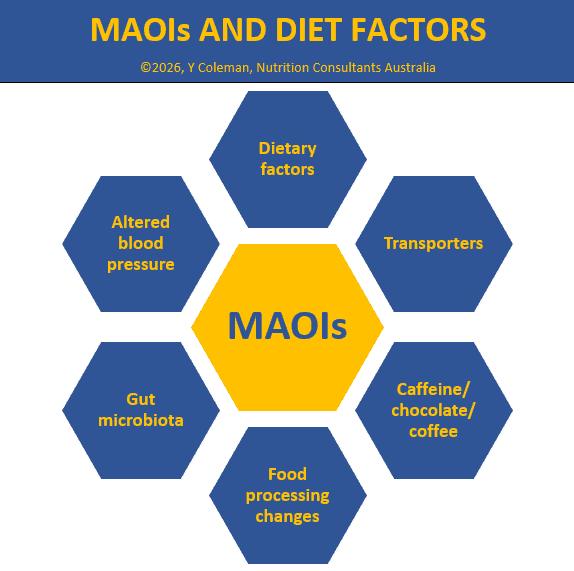
The MAOI dietary restrictions encompass many factors including dietary components, transporters, gut microbiota and a history of perceived food-induced harm.
MAOIs (Mono-Amine Oxidase Inhibitors)
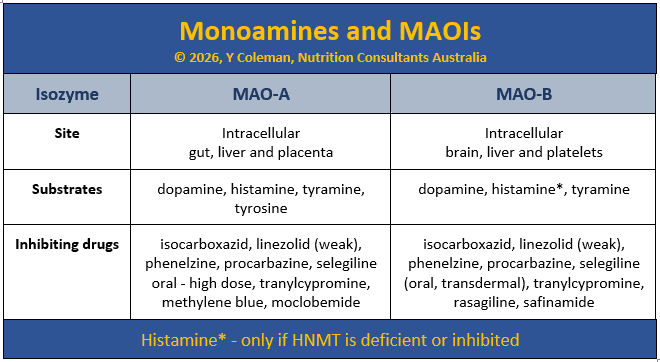
The monoamine oxidase system comprises 2 isozymes, being, MAO-A and MAO-B, and has 2 primary functions –
- directly regulates the absorption and metabolism of tyramine and dopamine,
- indirectly regulates the availability of histamine and serotonin.
MAO inhibition means removal of the regulators that control availability and uptake of tyramine, dopamine, histamine and serotonin. Excessive levels of these monoamines cause the precursors to be redirected to alternate systems, often with harmful outcomes.
MAOI drugs include isocarboxazid, linezolid, methylene blue, phenelzine, procarbazine, rasagiline, safinamide, high-dose selegiline (oral, transdermal), tranylcypromine.
Dietary factors
Harm perception
The potential harm, or perception of potential harm, of dietary tyramine causing a “hypertensive crisis” is longstanding. Even with effective management strategies, the limited understanding of this drug-food interaction continues to exacerbate the perception of harm.
Dietary matters
The primary substances of concern (SOCs) include dopamine, histamine and tyramine and their precursors histidine, levodopa, phenylalanine, tryptophan and tyrosine.
Aged/matured, dried, fermented, pickled, smoked or spoiled foodstuffs typically contain higher levels of SOCs.
Commencement of a MAOI intervention means the “potential risk of harm calculation” includes SOCs from both diet and supplements. Intake monitoring commences when a MAOI intervention is initiated, and continues for 2 weeks after the intervention has ceased. These restrictions also apply to the selegiline transdermal system at doses of 9+ mg/24 hours.
Tryptophan
Dietary tryptophan intake is usually not a problem. Because tryptophan supplements as 5-HTP (5-hydroxytryptophan) bypass the rate-limiter, they can cause significant serotonin-related problems.
Tyramine
Tyramine sources are both exogenous and endogenous. Exogenous sources include dietary intake and microbiota activity, whilst endogenous sources are very limited.
Dopamine levels regulate tyrosine hydroxylase activity. As dopamine levels increase, so tyrosine hydroxylase activity decreases.
Tyramine appears in the blood about 10 min after ingestion.
Histamine
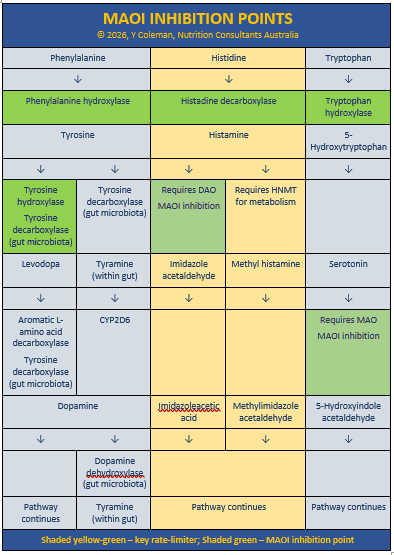
Histidine conversion to histamine comprises 2 pathways -
- DAO (Diamine oxidase) enzyme. Present in the intestinal epithelium, and protects the body from exogenous histamine (food, microbiota-generated).
- HNMT (Histamine N-methyltransferase) enzyme. Appears to protect the body from intravenous or intradermal histamine.
Recent evidence indicates MAO-B can directly metabolize histamine in vivo, but only when HNMT is inhibited or deficient. Consequently, HNMT inhibitors likely cause histamine oxidation through MAO-B isozyme activity.
A 2018 meta-analysis encompassing a 54-year timeframe, determined histamine intoxication was due to fish (98%) and cheese (2%). Histamine levels are determined by the degree of food freshness ie the fresher the food the lower the histamine content.
Both alcohol and histamine are metabolised by the enzyme aldehyde dehydrogenase (ALDH), and alcohol is typically prioritized. This means alcohol intake increases risk of a reaction.
Longstanding standard advice
This advice, and its variations, is extensive.
Avoid foods that have been matured/aged, fermented, pickled, smoked, or contaminated. Also avoid cheeses (especially aged varieties), pickled herring, beer, wine, liver, yeast extract (including brewer’s yeast in large quantities), dry sausage (including Genoa salami, hard salami, pepperoni, and Lebanon bologna), pods of broad beans (fava beans), yogurt, and excessive amounts of caffeine and chocolate.
Recent advice
To cause a noticeable Blood Pressure (BP) increase, a MAOI consumer requires about -
- 10+ mg of tyramine if tyramine-sensitive;
- 20+ mg of tyramine, if not tyramine-sensitive.
For most MAOI consumers, safe serves of high tyramine content foodstuffs include cheese ~ 25 g, and soy sauce ~ 10 mL.
Toxicity risks
The risk of toxicity includes both the total SOCs intake per meal plus trigger factors. For example, a platter of artisan cheeses (SOCs), served with a glass of wine (trigger). Actual triggers include related monoamines, individual responses, and synergies between foodstuffs ie not easy to identify.
Tyrosine + MAOI case study
Issue: Whether the concurrent administration of parenteral nutrition formula containing tyrosine, and a prescribed MAOI, can cause a negative reaction.
Intervention: The parenteral nutrition amino acid source provided 39 mg tyrosine/100 ml of solution.
Outcome: The intervention was closely monitored and deemed uneventful.
Monoamine content
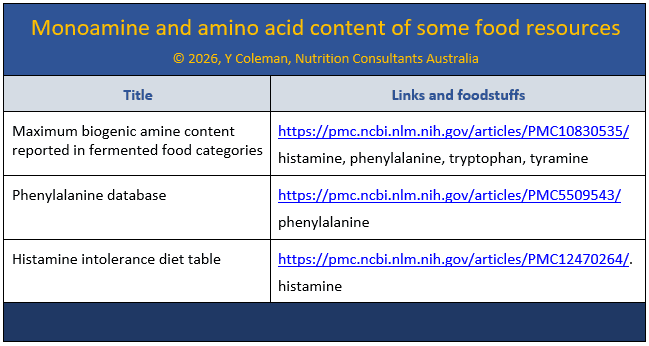
Reliable resources that encompass the content of monoamines and their precursors are limited. However, work in other areas such as PKU (phenylketonuria) has clarified the phenylalanine content of many foods. We can also look to those addressing histamine intolerance, perhaps food intolerances, and other areas.
Levodopa, high levels. Mucuna genus plant leaves and pods, especially Mucuna pruriens (velvet beans), Vicia faba, (broad beans), Cassia and Bauhinia seeds.
Phenylalanine. Rule of thumb content calculation –
Fruits and vegetables - ~ 40 mg/100g
Animal proteins - ~ 50 mg/100g
Other factors
Caffeine/coffee/chocolate
CYP1A2
A recent study found co-administration of coffee or caffeine with rasagiline resulted in significantly increased dopamine levels. This finding indicates concurrent caffeine plus rasagiline intake are likely inadvisable.
Both rasagiline and caffeine are substrates of CYP1A2 (cytochrome 1A2), which may be a relevant mechanism of action. If so, then potentially other substances that are substrates and/or inhibitors of CYP1A2 may also negatively impact the MAOI-1A2 interaction.
Methylene blue is an inhibitor of CYP1A2 which means increased availability of caffeine (and rasagiline).
MAOI inhibition
The recommendations to limit or avoid caffeine/chocolate/coffee relate to dopamine being a precursor for norepinephrine and epinephrine. Because MAOIs inhibit the breakdown of dopamine, norepinephrine, epinephrine, their levels remain high for a longer period, causing negative responses.
Food processing changes
Compared to mid-20th century standards, current food production processes have significantly reduced the levels of tyramine and other relevant monoamines. These significant reductions mean fewer, less-severe negative impacts. Notably, the older data (last century) is no longer indicative of current content.
Food processing systems that limit or inhibit monoamines include additives, hydrostatic pressure, irradiation, oxidizers (typically microbiota), packaging, pasteurization, smoking, starter cultures and temperature.
Transporters
LAT1 (large neutral amino acid transporter)
Function - the transport of a wide range of neutral amino acids, especially those with large branched or aromatic side chains.
Locations - high levels in the brain, spleen, bone marrow, testis, and placenta.
Substrates – tyrosine, levodopa, phenylalanine, histidine, tryptophan, baclofen, gabapentin, melphalan and pregabalin.
Bidirectional transport - histidine and tyrosine.
High affinity - histidine, phenylalanine and tryptophan.
Many amino acid-drug compounds that primarily utilize LAT1 can also interact with other transporters. Identified examples include OATPs (Organic Anion Transporting Proteins) and SNATs (Sodium-coupled neutral amino acid transporters). These LAT1+OATP and LAT1+SNAT combinations are secondary and tertiary transporter interactions that can significantly alter outcomes. These interactions become important if LAT1 is unavailable ie inhibited, saturated or dysfunctional.
- OATPs. Influx transporters that can carry relatively hydrophilic (water-based) and hydrophobic (oil-based) substrates from blood into organs and cells.
- SNATs. Transmembrane proteins that facilitate the cellular uptake of neutral amino acids in sodium- and pH-dependent manners.
B0AT1 (B0 amino acid transporter)
Co-expression of collectrin is essential for stable expression of B0AT1.
Function – primary transporter for the absorption of neutral amino acids in the intestine and their reabsorption in the kidney.
Location - high levels in the brush‐border of kidney and intestinal epithelial cells, and low levels in the brain.
Substrates include phenylalanine, tryptophan and histidine.
If BOAT1 is unavailable ie inhibited, saturated or dysfunctional, then precursor availability may also be altered.
Gut microbiota
Conversion of levodopa to dopamine and tyramine
A range of microbiota can -
- convert levodopa to dopamine utilizing tyrosine decarboxylase,
- dopamine to m-tyramine by a dopamine dehydroxylase.
Altered blood pressure
The combination of improved food production processes and increased dietary awareness means the risk of increased blood pressure is limited.
Increases in blood pressure further to excessive tyramine intake typically peak within 2 hours.
Regular blood pressure monitoring is recommended whilst a MAOI is prescribed, as a quick detection strategy for hypertensive crises.
Hypertensive definitions - systolic BP ≥ 180 mmHg and/or diastolic BP ≥ 110 mmHg -
- urgent - without end-organ damage;
- emergency - with end-organ damage.
Clinical concerns
Currently, a key focus of the MAOI-food interaction is monoamine tyramine content of foodstuffs. However, there are several other contributors that seem to be overlooked. Since most of the monoamines and their precursors are mostly present in similar foodstuffs, tyramine content may well be a useful guide.
Some key questions arise –
- whether the gut microbiota be manipulated, (diet, pharmaceuticals), to produce less tyramine?
- should the tyramine and histamine content of foodstuffs, and tryptophan form in supplements, be included on labels?
- whether LAT1 and BOAT1 should be added to the FDA list of required transporters for drug discovery purposes?
- could a comprehensive list of LAT1 and BOAT1 inhibitors be included in the MAOI Product Information documents?
Clinical questions
When you see someone prescribed a MAOI, will you -
- review their caffeine intake, and consider a decaffeinated alternative?
- clarify total intake of substances of concern?
- discuss food choices of concern, as highlighted in their diet history?
Conclusions
MAOI dietary restrictions typically require awareness and limited intake of a small number of foods likely to cause a reaction.
Bibliography
Araújo, ACMF., Araújo, WMC., Marquez, UML., Akutsu, R. & Nakano, EY. 2017. Table of Phenylalanine Content of Foods: Comparative Analysis of Data Compiled in Food Composition Tables. JIMD Reports 34:87-96. doi: 10.1007/8904_2016_12. Epub 2016 Oct 8. PMID: 27718212; PMCID: PMC5509543.
Bharani, T., Mogensen, KM., Rosen, JH., Gura, KM. & Robinson, MK. 2024. Concomitant use of monoamine oxidase inhibitor and tyrosine in parenteral nutrition. European Journal of Clinical Nutrition 78(3):274-276. doi: 10.1038/s41430-023-01375-8. Epub 2023 Dec 7. PMID: 38057413.
Bilal, R., Ahmad, NS., Zaffar, S., Mazhar, MU., Siddiqui, WA. & Tariq, S. 2022. Rasagiline Pharmacokinetics in CYP1A2 Variant Healthy Smokers & Non-smokers in Different Doses. Pakistan Journal of Medical Sciences 38(3Part-I):589-594. doi: 10.12669/pjms.38.3.4940. PMID: 35480532; PMCID: PMC9002453.
Bröer, S. 2009. The role of the neutral amino acid transporter B0AT1 (SLC6A19) in Hartnup disorder and protein nutrition. IUBMB Life 61(6):591-9. doi: 10.1002/iub.210. PMID: 19472175; PMCID: PMC7165679.
Comas-Basté, O., Sánchez-Pérez, S., Veciana-Nogués, MT., Latorre-Moratalla, M. & Carmen Vidal-Carou, M. 2020. Histamine Intolerance: The Current State of the Art. Biomolecules; Basel 10(8):1181. https://doi.org/10.3390/biom10081181
Daubner, SC., Le, T. & Wang, S. 2011. Tyrosine hydroxylase and regulation of dopamine synthesis. Archives of Biochemistry & Biophysics 508(1):1-12. doi: 10.1016/j.abb.2010.12.017. Epub 2010 Dec 19. PMID: 21176768; PMCID: PMC3065393.
Delport, A., Harvey, BH., Petzer, A. & Petzer, JP. 2018 Methylene Blue Analogues with Marginal Monoamine Oxidase Inhibition Retain Antidepressant-like Activity. ACS Chemical Neuroscience 9(12):2917-2928. doi: 10.1021/acschemneuro.8b00042. Epub 2018 Jul 25. PMID: 29976053.
Edinoff, AN., Swinford, CR., Odisho, AS., Burroughs, CR., Stark, CW., Raslan, WA., Cornett, EM., Kaye, AM. & Kaye, AD. 2022. Clinically Relevant Drug Interactions with Monoamine Oxidase Inhibitors. Health Psychology Research 10(4):39576. doi: 10.52965/001c.39576. PMID: 36425231; PMCID: PMC9680847.
Flockhart, DA., Thacker, D., McDonald, C. & Desta. Z. The flockhart cytochrome p450 drug-drug interaction table. Division of Clinical Pharmacology, Indiana University School of Medicine (Updated 2021). https://drug-interactions.medicine.iu.edu/main-table. Accessed 2026
Gasmi, A., Nasreen, A., Menzel, A., Gasmi Benahmed, A., Pivina, L., Noor, S., Peana, M., Chirumbolo, S. & Bjørklund, G. 2022. Neurotransmitters Regulation and Food Intake: The Role of Dietary Sources in Neurotransmission. Molecules 28(1):210. https://doi.org/10.3390/molecules28010210. PMID: 36615404; PMCID: PMC9822089.
Hiroi, T., Imaoka, S. & Funae, Y. 1998. Dopamine formation from tyramine by CYP2D6. Biochemical & Biophysical Research Communications 249(3):838-43. doi: 10.1006/bbrc.1998.9232. PMID: 9731223.
HMBD – Tyramine. https://hmdb.ca/metabolites/HMDB0000306. Accessed 2026
Holt, A. & Callingham, BA. 1995. Further studies on the ex-vivo effects of procarbazine and monomethylhydrazine on rat semicarbazide-sensitive amine oxidase and monoamine oxidase activities. Journal of Pharmacy & Pharmacology 47(10):837-45. doi: 10.1111/j.2042-7158.1995.tb05751.x. PMID: 8583353.
https://psychscenehub.com/psychinsights/maoi-psychopharmacology/. Accessed 2026
Huttunen, J., Kronenberger, T., Montaser, AB., Králová, A., Terasaki, T., Poso, A. & Huttunen, KM. 2023. Sodium-Dependent Neutral Amino Acid Transporter 2 Can Serve as a Tertiary Carrier for l-Type Amino Acid Transporter 1-Utilizing Prodrugs. Molecular Pharmaceutics 20(2):1331-1346. doi: 10.1021/acs.molpharmaceut.2c00948. Epub 2023 Jan 23. PMID: 36688491; PMCID: PMC9906736.
Jackson, K., Busse, W., Gálvez-Martín, P., Terradillos, A. & Martínez-Puig, D. 2025. Evidence for Dietary Management of Histamine Intolerance. International Journal of Molecular Science 26(18):9198. doi: 10.3390/ijms26189198. PMID: 41009760; PMCID: PMC12470264.
Jones, DN. & Raghanti, MA. 2021. The role of monoamine oxidase enzymes in the pathophysiology of neurological disorders. Journal of Chemical Neuroanatomy 114:101957. doi: 10.1016/j.jchemneu.2021.101957. Epub 2021 Apr 6. PMID: 33836221.
Maini Rekdal, V., Bess, EN., Bisanz, JE., Turnbaugh, PJ. & Balskus, EP. 2019. Discovery and inhibition of an interspecies gut bacterial pathway for Levodopa metabolism. Science 14:364(6445):eaau6323. doi: 10.1126/science.aau6323. PMID: 31196984; PMCID: PMC7745125.
Maršavelski, A., Mavri, J., Vianello, R. & Stare, J. 2022. Why Monoamine Oxidase B Preferably Metabolizes N-Methylhistamine over Histamine: Evidence from the Multiscale Simulation of the Rate-Limiting Step. International Journal of Molecular Sciences 23(3):1910. doi: 10.3390/ijms23031910. PMID: 35163835; PMCID: PMC8836602.
Methylene blue - Phebra website - https://www.phebra.com/wp-content/uploads/2018/10/Methylene-Blue-PI-V3.pdf. Accessed 2026-05-17
Nardil. FDA product information, last revised 2007. Accessed 2026
Patel P, Saadabadi A. Monoamine Oxidase Inhibitors (MAOIs). In: StatPearls [Internet]. Treasure Island (FL): StatPearls Publishing; 2026 Jan-. Available from: https://www.ncbi.nlm.nih.gov/books/NBK539848/
Rafehi, M., Faltraco, F., Matthaei, J., Prukop, T., Jensen, O., Grytzmann, A., Blome, FG., Berger, RG., Krings, U., Vormfelde, SV., Tzvetkov, MV. & Brockmöller, J. Highly Variable Pharmacokinetics of Tyramine in Humans and Polymorphisms in OCT1, CYP2D6, and MAO-A. Frontiers in Pharmacology 10:1297. doi: 10.3389/fphar.2019.01297
Ranganath, L., Khedr, M., Milan, AM., Davison, AS., Norman, BP., Janssen, MCH., Lock, EA., Bou-Gharios, G, & Gallagher, JA. 2023. Increased prevalence of Parkinson's disease in alkaptonuria. JIMD Reports 64. 10.1002/jmd2.12367.
Ruiz-Capillas, C. & Herrero, AM. 2019. Impact of Biogenic Amines on Food Quality and Safety. Foods 8(2):62. https://doi.org/10.3390/foods8020062. PMID: 30744001; PMCID: PMC6406683.
Saha Turna, N., Chung, R. & McIntyre, L. 2024. A review of biogenic amines in fermented foods: Occurrence and health effects. Heliyon 10(2):e24501. doi: 10.1016/j.heliyon.2024.e24501. PMID: 38304783; PMCID: PMC10830535.
Sidhu G, Marwaha R. 2025. Phenelzine. In: StatPearls [Internet]. Treasure Island (FL): StatPearls Publishing; 2026 Jan-. Available from: https://www.ncbi.nlm.nih.gov/books/NBK554508/. Accessed 2026
Solvo Biotechnology. https://www.solvobiotech.com/transporters/lat1. Accessed 2026
Sutton, J., Stroup, J. & Som, M. 2016. Linezolid-induced serotonin toxicity in a patient not taking monoamine oxidase inhibitors or serotonin receptor antagonists. Proceedings (Baylor University Medical Centre) 29(2):214-5. doi: 10.1080/08998280.2016.11929423. PMID: 27034576; PMCID: PMC4790578.
Van den Eynde, V., Abdelmoemin, WR., Abraham, MM., Amsterdam, JD., Anderson, IM., Andrade, C., Baker, GB., Beekman, ATF., Berk, M., Birkenhäger, TK., Blackwell, BB., Blier, P., Blom, MBJ., Bodkin, AJ., Cattaneo, CI., Dantz, B., Davidson, J., Dunlop, BW., Estévezm RF., Feinbergm SS., Finbergm JPM., Fochtmannm LJ., Gotlibm D., Holtm A., Inselm TR., Larsenm JK., Magom R., Menkesm DB., Meyerm JM., Nuttm DJ., Parkerm G., Regom MD., Richelsonm E., Ruhém HG., Sáiz-Ruizm J., Stahlm SM., Steelem T., Thase, ME., Ulrich, S., van Balkom, AJLM., Vieta, E., Whyte, I., Young, AH. & Gillman, PK. 2023. The prescriber's guide to classic MAO inhibitors (phenelzine, tranylcypromine, isocarboxazid) for treatment-resistant depression. CNS Spectrums 28(4):427-440. https://doi.org/10.1017/S1092852922000906. Epub 2022 Jul 15. PMID: 35837681.
Van den Eynde, V., Andrade, C., Berk, M., Feinberg, SS., Freeman, S., Nutt, D., Parker, G., Richelson, E., Rubin, R., Ruhe, E., Stahl, S., Young, A. & Gillman, PK. 2025. MAOI Antidepressants: A History Being Rewritten. Journal of Clinical Psychiatry 87(1):25com16111. https://doi.org/10.4088/JCP.25com16111. PMID: 41334978.
Van den Eynde, V., Gillman, PK. & Blackwell, BB. 2022. The Prescriber's Guide to the MAOI Diet-Thinking Through Tyramine Troubles. Psychopharmacology Bulletin 52(2):73-116. doi: 10.64719/pb.4434. PMID: 35721816; PMCID: PMC9172554.
Van den Eynde, V., Parker, G., Ruhé, HG., Birkenhäger, TK., Godet, L., Shorter, E. & Gillman, PK. 2023. On the Origins of MAOI Misconceptions: Reaffirming their Role in Melancholic Depression. Psychopharmacology Bulletin 53(3):35-54. doi: 10.64719/pb.4466. PMID: 37601082; PMCID: PMC10434306.
van Kessel, SP., Frye, AK., El-Gendy, AO., Castejon, M., Keshavarzian, A., van Dijk, G. & El Aidy, S. 2019. Gut bacterial tyrosine decarboxylases restrict levels of levodopa in the treatment of Parkinson’s disease. Nature Communications 10:310. https://doi.org/10.1038/s41467-019-08294-y
Xu, J., Hu, Z., Dai, L. Yadav, A., Jiang, Y., Bröer, A., Gardiner, MG., McLeod, M., Yan, R. & Bröer, S. 2024. Molecular basis of inhibition of the amino acid transporter B0AT1 (SLC6A19). Nature Communications 15:7224. https://doi.org/10.1038/s41467-024-51748-1
Cite: Coleman, Y. 2026. B12 and acid inhibitors. MedNut Mail https://medicationsandnutrition.com/maoi-diet-restrictions/ Accessed (date)
Professional Notice
The information in this article is designed to support healthcare professionals. It is not an exhaustive clinical protocol. Healthcare professionals are advised to maintain adequate professional supervision to ensure Duty of Care obligations with respect to safe administration of medicines is met for each individual consumer.
Core Philosophy
Whilst medications have profoundly improved global health outcomes, they typically also introduce nutritional challenges. By proactively identifying and addressing these nutritional harms, we can bridge the gap towards achieving better health outcomes.