Takeaway
The Invisible Risk: Drug-nutrition interactions are a critical blind spot in healthcare, often not noticed until complications arise.
Institutional Gaps: Healthcare systems frequently lack the structural frameworks required to track and manage these interactions.
Individual Oversight: Both clinicians and patients often underestimate how foods, nutrient supplements, and prescribed medications interact.
That drug-nutrition interactions are overlooked in the healthcare sector is concerning because nutrition is fundamental to our health and well-being.
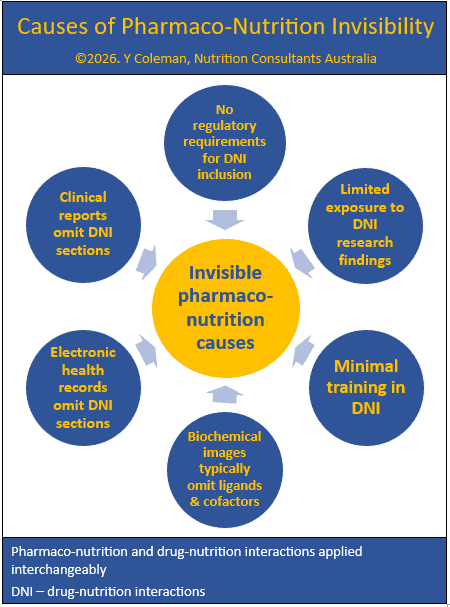
The terms pharmaco-nutrition, drug-nutrition interactions, drug-nutrient interactions are applied interchangeably.
Regulatory Requirements
Contribution to invisibility
Regulatory requirements are non-existent for the inclusion of drug impacts on nutrition factors in the drug discovery process. This omission means many potentially-treatable health issues relating to drug-induced nutrition compromise, are unlikely to be addressed.
Examples of excluded, relevant nutrition-related information include -
- mechanisms of action for drug-induced hyperglycaemia and drug-induced hypoalbuminaemia,
- identification of the specific binding site(s) on albumin for each drug, and the allosteric changes that binding causes. These two factors have profound impacts on nutrient distribution and consequent availability.
- identification of all the specific transporters that move each drug including duration of each drug’s occupancy, and duration of each drug’s inhibition of each transporter.
Increasing Visibility Strategies
Regulatory requirement for the inclusion of drug-induced negative nutrition impacts and their mechanisms of action. This information to also be included in the Product Information documents.
Examples of relevant nutrition-related information include –
- osmolality of all orally-ingested liquid pharmaceuticals,
- IDDSI-compliant texture modified administration recommendations for those with dysphagia,
- sodium content per dose,
- whether each medication alters urinary acid excretion.
Published Research Findings
Contribution to invisibility
Pharmaco-nutrition research findings are typically published in pharmaceutical or frontiers journals and rarely in medical or nutritional journals. Consequently, many health professionals have limited exposure to this research and its findings. This lack of exposure means non-inclusion of research findings into clinical practice and the benefits they confer in health outcomes.
Conferences
Conferences encompass multiple functions including the introduction of new knowledge to delegates. The dearth of published drug-nutrition interactions research in many relevant health professions journals, means presentations at conferences are also unlikely.
Increasing Visibility Strategies
Request publishers of journals for medical, pharmaceutical, nursing and dietetics professions to -
- publish annual editions dedicated to drug-nutrition interactions research, and/or
- include a defined drug-nutrition interactions section in each edition.
Include pharmaco-nutrition as a key topic at your next, and subsequent conferences.
Identify pharmaco-nutrition projects that students can complete and potentially present at conferences.
Training
Contribution to invisibility
Medical, pharmaceutical, nursing and dietetics students do not learn to notice and note pharmaco-nutrition interactions in their assessments and reviews. This omission typically continues into clinical practice.
Because these interactions are not identified and recorded, their incidence and prevalence are missed in auditing and research programs. Consequently, drug-nutrition interventions are erroneously perceived to be rare or clinically insignificant. These perceptions mean universities and health professions are less likely to include pharmaco-nutrition interactions into their training programs.
Increasing Visibility Strategies
Medical, pharmaceutical, nursing and dietetics professions mandate their student undergraduate programs include a comprehensive unit on drug-nutrition interactions.
Biochemical Pathways Images
Contribution to invisibility
Images of biochemical pathways are a useful format for understanding how interactions proceed. Biochemical pathways are currently presented in a variety of formats that include some or all compounds and enzymes.
Ligands and co-factors required for the enzymes to function within these biochemical pathways are rarely identified. Their omission means the importance of nutrition factors in physiological processes is invisible and therefore rarely considered when deciding therapeutic interventions.
Increasing Visibility Strategies
Encourage publishing houses and peer reviewers to require inclusion of ligands and cofactors in all images of biochemical pathways.
Electronic Health Record (EHR)
Contribution to invisibility
Electronic Health Records mostly identify drug-drug interactions but not drug-nutrition interactions (drug-nutrient, drug-food, drug-enteral formula, drug-nutrition support product).
Increasing Visibility Strategies
Redesign the EHR to match the administration times of prescribed drugs to food intake times (meals, snacks, enteral feeds). This matrix has the potential to identify and limit harmful interactions such as –
- those constituents within foodstuffs that interact with prescribed medications,
- the specific prescribed drugs that alter nutrient absorption, distribution, activation, and excretion.
Clinical Reports
Contribution to invisibility
Most clinical reports do not include a specific drug-nutrition interactions section within their data collection and evaluation components. Since these interactions are not identified, their management strategies won’t be considered and included in the assessment and recommendations sections.
Increasing Visibility Strategies
Clinical report templates include defined sections for drug-nutrition impacts in both the data collection, and the evaluation and recommendations sections.
Global introduction of a standardized clinical report template that includes drug-nutrition interactions section. An important outcome would be the quantification of drug-nutrition interactions.
Clinical Questions
Where are you on the zero to hero pathway in integrating the impacts of prescribed medications on nutrition factors? (zero – not yet started, hero – advocating institutional change).
Have you –
- redesigned your clinical report template to include drug impacts on nutrition factors? Which factors are you currently addressing?
- identified useful drug-nutrition interactions projects for students to complete?
- commenced advocating for inclusion of this important field in undergraduate programs and/or conferences and/or journals?
Conclusions
Drug-nutrition interactions omission in the healthcare sector encompasses many factors ranging from institutional to individual.
Bibliography
Mirmiran, P., Bahadoran, Z. & Gaeini, Z. 2021. Common Limitations and Challenges of Dietary Clinical Trials for Translation into Clinical Practices. International Journal of Endocrinology & Metabolism 19(3):e108170. doi: 10.5812/ijem.108170. PMID: 34567133; PMCID: PMC8453651.
Advinha, AM., Fernandes, JP. & Perdigão, M. 2024. Food-drug interactions risk management: An emergent piece of pharmacovigilance systems. Pharmacology Research & Perspectives 12(4):e1245. doi: 10.1002/prp2.1245. PMID: 38992909; PMCID: PMC11239764.
Cite: Coleman, Y. 2026. Why drug-nutrition interactions are overlooked in healthcare. MedNut Mail https://medicationsandnutrition.com/why-drug-nutrition-interactions-are-overlooked-in-healthcare/ Accessed (date)
Why drug-nutrition interactions are overlooked in the healthcare sector
Professional Notice
The information in this article is designed to support healthcare professionals. It is not an exhaustive clinical protocol. Healthcare professionals are advised to maintain adequate professional supervision to ensure Duty of Care obligations with respect to safe administration of medicines is met for each individual consumer.
Core Philosophy
Whilst medications have profoundly improved global health outcomes, they typically also introduce nutritional challenges. By proactively identifying and addressing these nutritional harms, we can bridge the gap towards achieving better health outcomes.