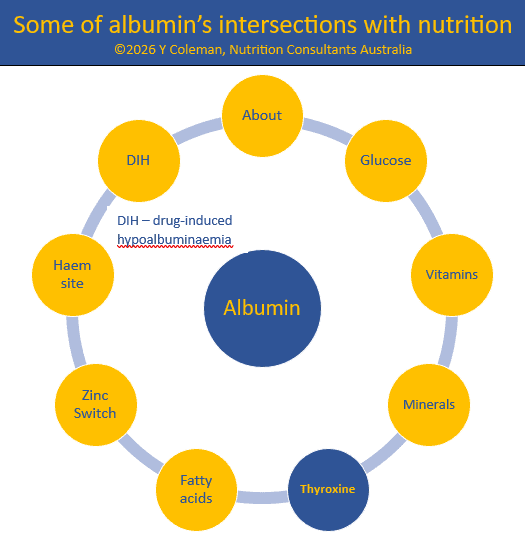
Albumin and thyroxine, either separately or together, are important contributors to most of our physiological functions.
Takeaways
Albumin and thyroxine have essential roles in maintaining overall metabolic and physiological functions.
Prescribed medications can significantly alter the levels, efficiency and effectiveness of these essential proteins.
Drugs can impact through both direct biochemical interference, and indirect metabolic changes
Thyroxine
Albumin carries about 10% of the thyroid hormone thyroxine. Binding of thyroxine to albumin is managed allosterically which means changes elsewhere on albumin structure can alter its thyroxine-carrying capacity.
Thyroxine is both produced naturally and can be administered therapeutically. It binds to five sites on albumin, being Tr-1, Tr-2, Tr-3, Tr-4 and Tr-5. These partially overlap the Fatty Acid (FA) binding sites FA3-4, FA5, FA7, FA9. Thyroxine’s primary binding site on albumin is currently disputed with various authors claiming each of the various sites.
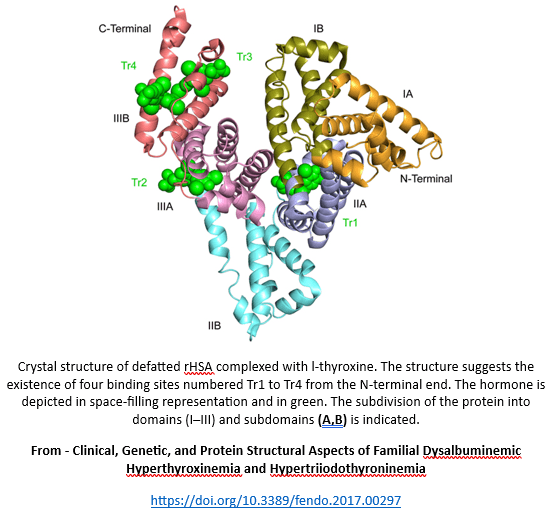
Thyroxine binding sites
Thyroxine site
FA sites
Comments
Tr-1
Subdomain IIA; FA7, Sudlow site 1 *
Trp214 (IIA), Arg218 (IIA) and Arg 222 (IIA) are not affected by thyroxine binding to Tr-1.
Tr-2
Subdomain IIIA; FA3-4, Sudlow site II *
FA3 - binds fatty acids –
- linearly - ≤ 12–14 carbons,
- folded ≥ 12–14 carbons.
The folding of long chain PUFAs may be a functional prerequisite.Tr-3
Subdomain IIIB; FA5
Binds up to two thyroxine molecules.
Tr-4
Subdomain IIIB; FA5
Binds up to two thyroxine molecules.
Tr-5
Between domains I + III i.e. FA9
A high-affinity site for thyroxine in the presence of excess fatty acid.One mol albumin typically carries 1–2 mol FAs. An increased quantity is required to stimulate the structural changes necessary to create Tr-5 site.
* Confusion seems to exist regarding FA7 and Sudlow Site 1, and FA3-4 and Sudlow Site 2. Some authors use both terms interchangeably whilst others maintain separate sites with significant overlap.
Glycation
An inverse correlation seems to exist between degree of glycation and fatty acid binding affinity. As the degree of glycation increases, so the binding affinities of fatty acids change. Initial evidence indicates 3 sites (FA2, FA4, FA5) retain high affinity whilst other sites assume low affinity. Glycation can therefore indirectly alter thyroxine’s binding capacity to albumin through FA4 and FA5.
Fatty Acids
Fatty acids compete with thyroxine for binding at all its sites, and also –
- inhibit the binding of thyroxine if the fatty acid:albumin ratio is high,
- induce structural changes to albumin eg creation of a fifth thyroxine binding site,
- alter albumin’s capacity to carry thyroxine.
Thyroxine binding sites
Subdomain
Thyroxine binding sites.
IA
IB
IIA
Tr-1
IIB
IIIA
Tr-2
IIIB
Tr-3, Tr-4
Domains I + II interface
Tr-5
Clinical Concerns
The research seems to still be at the “what is going on” stage, and has not yet reached the “what can we do about it nutritionally” stage.
Clinical Questions
What actions will you initiate as you a review a person who is prescribed one or more drugs that utilize albumin as a carrier -
- will you clarify and monitor thyroid function?
- if thyroid function is altered, will you question whether a contributing factor could be some of the prescribed medicines altering albumin’s capacity to carry thyroxine?
Conclusions
Albumin and thyroxine are important in maintaining body function, and are negatively impacted both directly and indirectly, by prescribed medicines.
Bibliography
Ascenzi, P., di Masi, A., Fanali, G. & Fasano, M. 2015. Heme-based catalytic properties of human serum albumin. Cell Death Discovy 1:15025. doi: 10.1038/cddiscovery.2015.25. PMID: 27551458; PMCID: PMC4991842.
Al-Harthi, S., Lachowicz, JI., Nowakowski, ME., Jaremko, M. & Jaremko, Ł. 2019. Towards the functional high-resolution coordination chemistry of blood plasma human serum albumin. Journal of Inorganic Biochemistry 198:110716. https://doi.org/10.1016/j.jinorgbio.2019.110716. Epub 2019 May 20. PMID: 31153112.
Fasano, M., Curry, S., Terreno, E., Galliano, M., Fanali, G., Narciso, P., Notari, S. & Ascenzi, P. 2005. The extraordinary ligand binding properties of human serum albumin. IUBMB Life 57: 787-796. https://doi.org/10.1080/15216540500404093
Alexandri, E., Venianakis, T., Primikyri, A., Papamokos, G. & Gerothanassis, IP. 2023. Molecular Basis for the Selectivity of DHA and EPA in Sudlow's Drug Binding Sites in Human Serum Albumin with the Combined Use of NMR and Docking Calculations. Molecules 28(9):3724. https://doi.org/10.3390/molecules28093724. PMID: 37175134; PMCID: PMC10180286.
Alexandri, E., Primikyri, A., Papamokos, G., Venianakis, T., Gkalpinos, V.K., Tzakos, A.G., Karydis-Messinis, A., Moschovas, D., Avgeropoulos, A. and Gerothanassis, I.P. 2022. NMR and computational studies reveal novel aspects in molecular recognition of unsaturated fatty acids with non-labelled serum albumin. FEBS Journal 289: 5617-5636. https://doi.org/10.1111/febs.16453
Kragh-Hansen, U., Galliano, M. & Minchiotti, L. 2017. Clinical, Genetic, and Protein Structural Aspects of Familial Dysalbuminemic Hyperthyroxinemia and Hypertriiodothyroninemia. Frontiers in Endocrinology (Lausanne) 8:297. https://doi.org/10.3389/fendo.2017.00297. PMID: 29163366; PMCID: PMC5671950.
Ashraf, S., Qaiser, H., Tariq, S., Khalid, A., Makeen, HA., Alhazmi, HA. & Ul-Haq, Z. 2023. Unraveling the versatility of human serum albumin - A comprehensive review of its biological significance and therapeutic potential. Current Research in Structural Biology 27(6):100114. https://doi.org/10.1016/j.crstbi.2023.100114. PMID: 38111902; PMCID: PMC10726258.
Cite: Coleman, Y. 2025. Albumin and thyroxine. MedNut Mail https://medicationsandnutrition.com/albumin-and-thyroxine/ Accessed (date)
Albumin and thyroxine
Professional Notice
The information in this article is designed to support healthcare professionals. It is not an exhaustive clinical protocol. Healthcare professionals are advised to maintain adequate professional supervision to ensure Duty of Care obligations with respect to safe administration of medicines is met for each individual consumer.
Core Philosophy
Whilst medications have profoundly improved global health outcomes, they typically also introduce nutritional challenges. By proactively identifying and addressing these nutritional harms, we can bridge the gap towards achieving better health outcomes.