Takeaways
Albumin is a primary carrier in the bloodstream which means drug-induced changes to it can significantly impact how minerals are distributed and utilized.
Understanding these interactions means clinicians can monitor for and manage their potential complications .
Albumin and minerals in combination encompass a broad range of physiological functions – and yet the research is surprisingly limited.
Multiple metal binding sites within the albumin structure enables it to carry key minerals such as calcium, cobalt, copper, manganese, magnesium, selenium, zinc.
The Importance of Zinc
The interdependence of albumin and insulin is regulated by zinc availability. Zinc is important in the production and availability of insulin, and its release from insulin enables insulin activation. The released zinc then attaches to albumin – and albumin’s capacity to bind zinc regulates the availability of active insulin. Further, insulin levels directly affect albumin synthesis ie low insulin levels cause reduced albumin synthesis and vice versa.
Non-esterified fatty acids (NEFAs) encompass both saturated and unsaturated forms. NEFAs are also transported by albumin, and their binding to FA2 (Fatty Acid 2 site) triggers albumin to release zinc. As NEFA levels increase so albumin’s capacity to bind zinc diminishes resulting in reduced availability of activated insulin.
Albumin's Binding Sites for Minerals
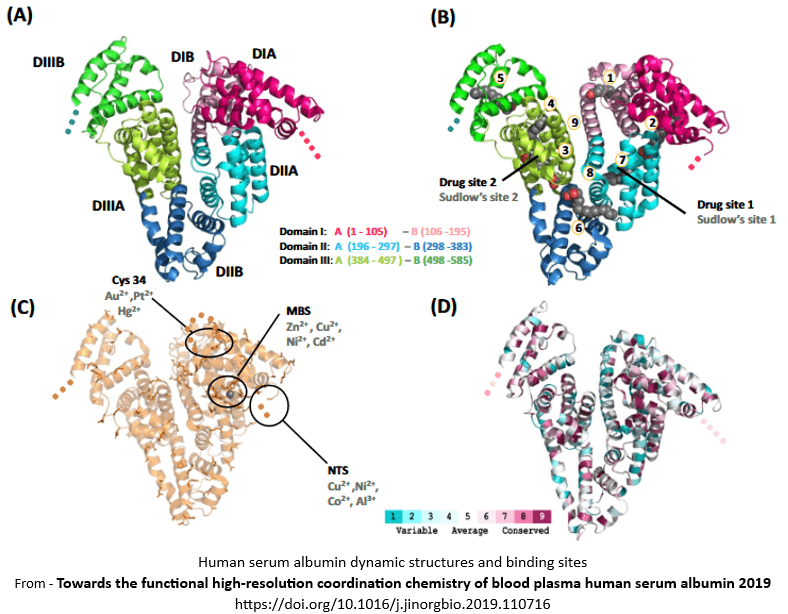
Albumin’s capacity to bind minerals is based on 7 amino acids that are located within 4 binding sites.
The 7 amino acids are arginine (Arg), aspartic acid (Asp), cysteine (Cys), glutamic acid (Glu), histidine (His), lysine (Lys), tryptophan (Trp) and are commonly called “residues”.
The 4 four metal binding sites are –
1. Site A - aka Multi-metal Binding Site A or MBS-A or Cadmium site A
Located at the domain I/II interface with residues from both domains involved in the interactions.
Site A's location also overlaps with the FA2 site. Binding on one site may alter binding capability on the other site.
Involves His67, Asn99, His247, and Asp249 residues.
2. Site B - aka Multi-metal Binding Site B or MBS-B or Cadmium site B
May also be an inter-domain site however its location and details are currently indeterminate.
3. NTS - aka N-terminal binding site, or ‘ATCUN’ (Amino Terminal Copper and Nickel binding site)
Located in subdomain IA at the N-terminus.
Involves Asp1, Ala2, and His3 residues.
4. Cys-34
Located in subdomain IA.
Binds gold, mercury and platinum ions.
Albumin’s metal binding sites
Distribution of minerals and their binding sites
Table of minerals and their known binding sites on albumin
Calcium
Subdomain IIA – Asp-249,
Sites A + B.Chloride
Status unknown for chloride ions.
Chromium
Location indeterminate.
Cobalt
Site B – primary,
His-9, His-67;
Site A – secondary,
His-9, His-67;
NTS;
Cys-34 – does not bind cobalt.Copper
NTS – primary,
Subdomain IA - Asp1-Ala2-His3. His-3 is considered essential;
Site-A – secondary,
Interdomain I/II interface, surrounded by FA1, FA2, and FA7 binding sites.Fluoride
Status unknown for fluoride ions.
Iodine
Status unknown for fluoride ions.
Iron
Haem complex - subdomain IB,
Tyr138, Tyr161, and FA1.Magnesium
Domain II – Asp-249,
Sites A + B.Manganese
Site B – primary;
Site A – secondary.Molybdenum
Location currently indeterminate.
Potassium
No evidence of carriage by albumin.
Selenium
Cys34 – subdomain IA;
Assumed binding site for selenium compounds.Sodium
No evidence of carriage by albumin.
Sulfur
Status indeterminate for sulfur ions.
Zinc
Site A – primary,
Domain I - His67, Asn99,
Domain II - His247, Asp249.
Site II – secondary,
Subdomain IA – His9, Asp13,
Subdomain IIA - Asp255.
Site III – secondary,
Between IB and IIA domains – His157, His288 and Glu153.
Cys34 does not bind to zinc.Clinical Concerns
Albumin is the primary carrier of several key physiological minerals. The evidence is extraordinarily limited regarding –
- the location of each mineral’s binding site(s),
- the factors that alter the binding site’s capacity to carry them.
Further, although some minerals are carried on the same binding site, we don’t know what determines access. In order to appropriately manage potential drug-mineral interactions, we do need to know and understand the access determinants to albumin. Essential factors include whether access is based on timing ie first come first access, or whether access is priority-based. If access is priority-based then what is the order of access, and what are the factors that alter it?
Clinical Questions
What actions will you initiate as you a review a person whose prescribed medications profile includes one or more drugs that utilize albumin as a carrier, will you -
• clarify and monitor adequacy of intake of the minerals carried by albumin that are potentially affected by their prescribed medicines?
Conclusions
Albumin and minerals in combination can have their functions impacted both directly and indirectly, by prescribed medicines.
Bibliography
Grüngreiff, K., Gottstein, T., Reinhold, D. & Blindauer, C.A. 2021. Albumin Substitution in Decompensated Liver Cirrhosis: Don’t Forget Zinc. Nutrients 13:4011. https://doi.org/10.3390/nu13114011
Mishra, V. & Heath, R.J. 2021. Structural and Biochemical Features of Human Serum Albumin Essential for Eukaryotic Cell Culture. International Journal of Molecular Science 22:8411. https://doi.org/10.3390/ijms22168411
Ashraf, S., Qaiser, H., Tariq, S., Khalid, A., Makeen, HA., Alhazmi, HA. & Ul-Haq, Z. 2023. Unraveling the versatility of human serum albumin - A comprehensive review of its biological significance and therapeutic potential. Current Research in Structural Biology 27(6):100114. https://doi.org/10.1016/j.crstbi.2023.100114. PMID: 38111902; PMCID: PMC10726258.
Al-Harthi, S., Lachowicz, JI., Nowakowski, ME., Jaremko, M. & Jaremko, Ł. 2019. Towards the functional high-resolution coordination chemistry of blood plasma human serum albumin. Journal of Inorganic Biochemistry 198:110716. https://doi.org/10.1016/j.jinorgbio.2019.110716. Epub 2019 May 20. PMID: 31153112.
Belinskaia, DA., Voronina, PA., Shmurak, VI., Jenkins, RO. & Goncharov, NV. 2021. Serum Albumin in Health and Disease: Esterase, Antioxidant, Transporting and Signaling Properties. International Journal of Molecular Science 22(19):10318. https://doi.org/10.3390/ijms221910318. PMID: 34638659; PMCID: PMC8508759.
Fu, M., Zhang, L., Killeen, R., Onugwu, KE., McCarrick, RM. & Hagerman, AE. 2025. Green Tea Polyphenol Epigallocatechin Gallate Interactions with Copper-Serum Albumin. Molecules 30:320. https://doi.org/10.3390/molecules30020320
Li, C., Zhang, D., Pan, Y. & Chen, B. 2023. Human Serum Albumin Based Nanodrug Delivery Systems: Recent Advances and Future Perspective. Polymers 15:3354. https://doi.org/10.3390/polym15163354
Shevtsova, A., Gordiienko, I., Tkachenko, V., & Ushakova, G. 2021. Ischemia-Modified Albumin: Origins and Clinical Implications. Disease Markers 2021:9945424. https://doi.org/10.1155/2021/9945424. PMID: 34336009; PMCID: PMC8315882.
Frączyk, T. 2021. Phosphorylation Impacts Cu(II) Binding by ATCUN Motifs. Inorganic Chemistry 60(12):8447-8450. https://doi.org/10.1021/acs.inorgchem.1c00939. Epub 2021 Jun 7. PMID: 34097387; PMCID: PMC8277166.
Silva, AMN. & Rangel, M. 2022. The (Bio)Chemistry of Non-Transferrin-Bound Iron. Molecules 27(6):1784. https://doi.org/10.3390/molecules27061784. PMID: 35335148; PMCID: PMC8951307.
Wu, D., Gucwa, M., Czub, MP., Cooper, DR., Shabalin, IG., Fritzen, R., Arya, S., Schwarz-Linek, U., Blindauer, CA., Wladek Minor, W. & Stewart, AJ. 2023. Structural and biochemical characterisation of Co2+ -binding sites on serum albumins and their interplay with fatty acids. Chemical Science 14:6244.
Cite: Coleman, Y. 2025. B12 absorption. MedNut Mail https://medicationsandnutrition.com/b12-absorption/ Accessed (date)
Albumin and minerals in combination
Professional Notice
The information in this article is provided to support Health Professionals. It is not an exhaustive protocol and Health Professionals are advised that adequate professional supervision is accessed to ensure that Duty of Care obligations with respect to safe administration of medicines is met for each consumer.
Core Philosophy
Whilst medications have profoundly improved global health outcomes, they typically also introduce nutritional challenges. By proactively identifying and addressing these nutritional harms, we can bridge the gap towards achieving better health outcomes.