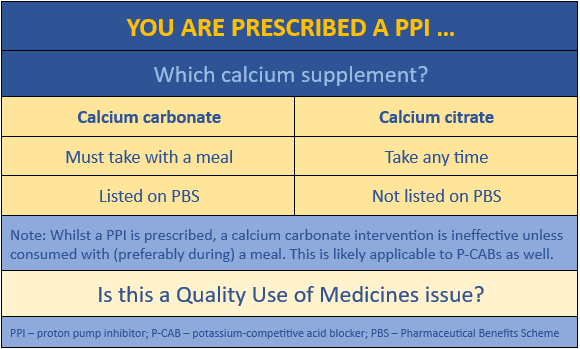
Calcium and acid inhibitors and QUM are a seemingly unusual combination. Some acid inhibitors may reduce the effectiveness of some calcium interventions. What does this have to do with QUM (Quality Use of Medicines)?
Mechanisms and consequences
The relationships
The therapeutic effectiveness of calcium carbonate when an acid inhibitor is also prescribed, is being questioned. Is calcium carbonate the best option? Why is it the preferred option?
Calcium
Calcium is not absorbed in the stomach it is absorbed in the intestines. The stomach is where calcium is either converted to a soluble form such as Ca2+ or is bound to a soluble organic molecule. This solubilization enables its intestinal absorption.
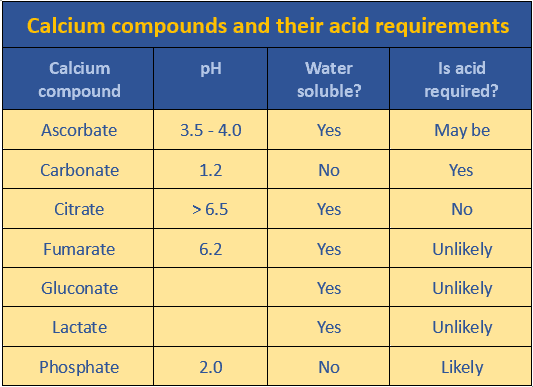
Release of calcium from its compound may require a source of acid – either gastric or dietary.
Acid inhibitors
Acid inhibitors reduce the amount of acidity released from the gastric parietal cells into the stomach, and include -
H2 antagonists (H2As). Block the histamine receptors. Increase gastric pH to a median of about 2-3. Can maintain intragastric pH > 4 for 4 hours. Short duration of effect.
Proton pump inhibitors (PPIs). Inhibit the proton pumps. Increase gastric pH to about 4-6. Can maintain intragastric pH > 4 for 15-22 hours.
Potassium-competitive acid blockers (P-CABs). Bind to proton pumps in a K+-competitive manner. Early evidence indicates they maintain a pH > 4 for longer than PPIs.
Comments about PPIs in this post are deemed relevant to P-CABs because of their many similarities. However, there is currently no specific evidence likely due to their recent formulation.
Quality Use of Medicines (QUM)
QUM’s role is to improve medication safety and quality by reducing prescription errors and harm. Its initiatives include –
- promotion of appropriate, judicious, safe and effective medication use,
- reviewing prescription data to facilitate improvement.
Ultimately QUM is about the administration of the correct medicine, at the appropriate time, to the right person.
Calcium and acid inhibitors
A common prescription combination is calcium carbonate and a PPI. A P-CAB and calcium combination is likely to become commonplace as more is known about P-CABs. Duration of these prescription combinations is typically years not months.
PPI prescription means suppression of gastric acidity. Absorption of calcium from calcium carbonate is minimal if administered whilst fasting ie on an empty stomach. Calcium carbonate must therefore be taken at mealtimes.
Calcium from calcium citrate is not dependent on pH for absorption and therefore can be administered at any time.
H2As are considered unlikely to negatively impact calcium status.
Pharmaceutical Benefits Scheme (PBS) influence
The PBS is the vehicle by which the government subsidises the cost of medicine for most medical conditions.
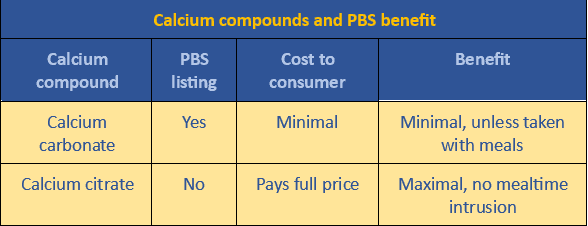
Ultimately which calcium intervention is recommended seems to be based on cost to the consumer.
QUM
The cost versus benefit issue makes this a QUM matter.
Prescribers and consumers are unaware concurrent prescription of a PPI means calcium carbonate interventions are ineffective unless taken with meals.
My spot check of PPI documents found neither their Consumer Medicine Information (CMI) nor their Product Information (PI) include recommendations that -
- calcium carbonate interventions should be administered with meals;
- calcium citrate interventions can be administered at any time.
This omission means -
- the right consumer is being given the right intervention likely at the wrong time; and therefore
- the taxpayer is subsidizing an ineffective intervention.
I suggest 2 strategies to address this significant QUM issue –
- PBS listing for calcium citrate;
- require the CMI and PI documents for PPIs to include appropriate calcium management strategies.
Currently the medicine may be correct but the timing may not be.
Clinical concerns
What actions will you initiate when you see someone prescribed both calcium carbonate and a PPI – will you -
- check that the calcium carbonate intervention is being consumed with meals?
- recommend changing to calcium citrate to ensure adequate calcium absorption?
- contact your pharmaceutical Regulator and request appropriate calcium management strategies be included in the CMI and PI when prescribed a PPI?
Conclusions
Calcium and acid inhibitors are a combination that requires the right medicine to be administered at the right time. But is it?
Bibliography |
|---|
https://www.safetyandquality.gov.au, search term QUM. Accessed 2026-01-26. |
Nugent, CC., Falkson, SR. & Terrell, JM. 2024. H2 blockers. Stat Pearls. BCBI Bookshelf. Accessed 2026-01-26. |
Pharmaceutical Society of Australia. 2020. Guidelines for Quality Use of Medicines (QUM) services. Pharmaceutical Society of Australia |
Beto, JA. 2015. The Role of Calcium in Human Aging. Clinical Nutrition Research 4:1-8. http://dx.doi.org/10.7762/cnr.2015.4.1.1 |
Begg, M., Tarhuni, MN., Fotso, M., Gonzalez, NA., Sanivarapu, RR., Osman, U., Latha, KA., Sadagopan, A., Mahmoud, A. & Khan, S. 2023. Comparing the Safety and Efficacy of Proton Pump Inhibitors and Histamine-2 Receptor Antagonists in the Management of Patients With Peptic Ulcer Disease: A Systematic Review. Cureus 15(8):e44341. https://doi.org/10.7759/cureus.44341. |
Anda Mihaela Naciu, AM., Giosuè Giordano Incognito, GG., Gherardo Mazziotti, G. & Palermo, A. 2022. Calcium Citrate Versus Calcium Carbonate in the Management of Chronic Hypoparathyroidism: A Randomized, Double‐Blind, Crossover Clinical Trial. Journal of Bone and Mineral Research 37(7):1251–1259. https://doi.org/10.1002/jbmr.4564 |
Drago, SR., Binaghi, MJ. & Valencia, ME. 2005. Effect of Gastric Digestion pH on Iron, Zinc, and Calcium Dialyzability from Preterm and Term Starting Infant Formulas. Journal Of Food Science 70(2):S107. |
Dolinska, B., Mikulska, A., Caban, A., Ostrozka-Cieslik, A. & Ryszka, F. 2011. A model for calcium permeation into small intestine. Biological Trace Element Research 142(3):456-64. |
Lee, JK., Jung, SH., Lee, SE., Han, JH., Jo, E., Park, HS., Heo, KS., Kim, D., Park, JS. & Myung, CS. 2018-. Alleviation of ascorbic acid-induced gastric high acidity by calcium ascorbate in vitro and in vivo. Korean Journal of Physiology & Pharmacology 22(1):35-42. https://doi.org/10.4196/kjpp.2018.22.1.35. |
Dickerson, B., Gonzalez, D. E., Sowinski, R., Xing, D., Leonard, M., Kendra, J., Jenkins, V., Gopalakrishnan, S., Yoo, C., Ko, J., Pillai, S. S., Bhamore, J. R., Patil, B. S., Wright, G. A., Rasmussen, C. J., & Kreider, R. B. 2024. Comparative Effectiveness of Ascorbic Acid vs. Calcium Ascorbate Ingestion on Pharmacokinetic Profiles and Immune Biomarkers in Healthy Adults: A Preliminary Study. Nutrients 16(19):3358. https://doi.org/10.3390/nu16193358. |
Patel, A. 2024. Calcium gluconate: more than just a supplement. https://annexechem.com/calcium-gluconate-guide/ Accessed 2026-01-28 |
Nieto, JA., Soriano-Romaní, L., Tomás-Cobos, L., Sharma, L. & Budde, T. 2021. Improved in vitro bioavailability of a newly developed functionalized calcium carbonate salt as a food ingredient and its comparison with available commercial calcium salts. Food Chemistry 348:128740. https://doi.org/10.1016/j.foodchem.2020.128740 |
Shkembi, B. & Huppertz, T. 2022. Calcium Absorption from Food Products: Food Matrix Effects. Nutrients 14(1):180. https://doi.org/10.3390/nu14010180 |
Qiao, X. & Li, P. 2025. Potassium-competitive acid blockers and advances in the management of patients with acid-related diseases: a narrative review. Frontiers in Physiology. 16:1655102. https://doi.org/10.3389/fphys.2025.1655102 |
Anderson, C., Eggert, L., Fitzgerald, K., Jackson, D. & Farr, F. 2022. Calcium and phosphate solubility curve equation for determining precipitation limits in compounding parenteral nutrition. Hospital Pharmacy 57(6):779-785. https://doi.org/10.1177/00185787221104367 |
Wagner, M., Hess, T. & Zakowiecki, D. 2022. Studies on the pH-Dependent Solubility of Various Grades of Calcium Phosphate-based Pharmaceutical Excipients. Journal of Pharmaceutical Sciences 111(6):1749-1760. https://doi.org/10.1016/j.xphs.2021.12.005 |
Weerapol, Y., Cheewatanakornkool, K. & Sriamornsak, P. 2010. Impact of Gastric pH and Dietary Fiber on Calcium Availability of Various Calcium Salts. Silpakorn University Science and Technology Journal 4 (1):15-23. |
Please read this as it is important …
The information in this article is provided to support Health Professionals. It is not an exhaustive protocol and Health Professionals are advised that adequate professional supervision is accessed to ensure that Duty of Care obligations with respect to safe administration of medicines is met for each consumer.