Can choline treat raised B6 and B12 levels directly, and why are they raised, are 2 key questions.
Choline, B6, and B12 each contribute different benefits typically within the same range of physiological functions. Key physiological functions include – one-carbon metabolism, tryptophan–kynurenine pathway, amino acid metabolism, membrane-lipid metabolism, neurological biochemistry.
Relationships between choline, B6 and B12
One-carbon metabolism is an example of the interrelationships of choline, B6 and B12.
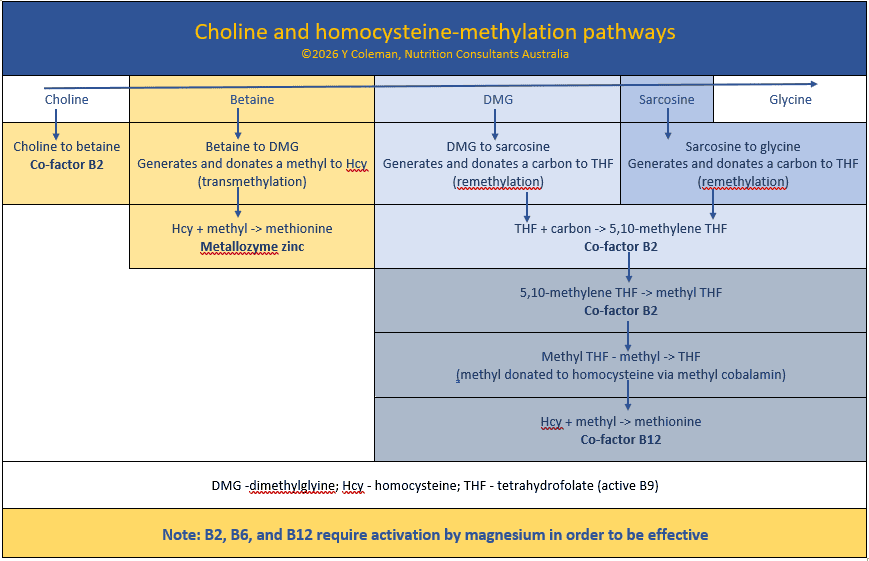
Choline primarily has a structural function that physically changes as it progresses to its end-product - in this case glycine.
Vitamins B2, B6 and B12 are primarily cofactors for key interactions. For example, riboflavin (B2) is essential for the conversion of tetrahydrofolate (THF) to 5,10-methylene THF. Their levels are not diminished by their participation in the various conversion processes.
Choline to homocysteine mechanisms
Choline generates betaine, and requires B2 for the conversion to proceed.
Betaine conversion to DMG (dimethylglycerine) generates and donates a methyl for the homocysteine to methionine conversion within the transmethylation cycle.
Dimethylglycerine conversion to sarcosine generates and donates a carbon to THF (tetrahyrofolate) to form 5,10-methylene THF within the remethylation cycle. B2 is required for this conversion to proceed.
Sarcosine conversion to glycine generates and donates a carbon to THF to form 5,10-methylene THF within the remethylation cycle. B2 is required for this conversion to proceed.
The conversion of 5,10-methylene THF to methyl THF requires B2.
The Methyl THF to THF conversion donates a methyl to homocysteine for the conversion of homocysteine to methionine to proceed. As the methyl-carrier, B12 is required for this conversion to proceed.
Vitamin B6 does not participate in the either the remethylation or transmethylation processes triggered by choline. Instead, it is essential in the transsulfuration process which converts excess homocysteine to cystathionin and cysteine.
Mechanisms that enable choline to directly lower B6 or B12 levels to normal range seem to be lacking.
Raised B6 + B12 levels
Are both nutrients raised due to the same cause or due to different causes?
Adequacy of dietary intake needs to be established. Does the diet history, including nutrient supplement intake, indicate an adequate or an excessive intake of B6 and/or B12?
If the diet history shows an adequate intake, then something else is likely causing the elevation.
Prescribed medications are the most likely candidates as they may be either occupying or inhibiting the B6 and/or B12 transporters. We don't know duration of each drug’s inhibition of the various transporters involved ...
Mapping transporters and their nutrients in conjunction with prescribed medications is a useful strategy for identifying altered transporter effectiveness.
Do any of the prescribed medications contain B6 and/or B12 as excipients (ingredients)?
The FDA requires only 9 transporters to be included in the drug discovery process which limits the capacity for problem-solving. Currently unidentified transporters may also be altering nutrient movements into and out of the blood.
B12 injectables
If B12 is administered by injection, and has been a long-term intervention, then B12 levels are likely to be elevated. Management strategies should include checking B12 levels about a week before the next scheduled intervention. If B12 is elevated then consider reducing injection frequency and monitor until levels are within acceptable range (~ 800 pmol/L). Both dose and/or frequency of intervention may require adjustments to stabilise B12 levels within acceptable range.
Pharmaceutical impacts on nutrition-related factors are not a required part of the drug discovery process. Try asking the pharmaceutical companies whether their products’ side effects include raised nutrient levels, and their likely mechanisms of action. This is a useful strategy for highlighting an important knowledge gap!
Conclusions
Whether choline can treat raised B6 and B12 levels directly seems unlikely. Determining the cause of the raised levels is essential.
Bibliography |
|---|
Azimi, Z., Isa, M. R., Khan, J., Wang, S. M. & Ismail, Z. 2022. Association of zinc level with DNA methylation and its consequences: A systematic review. Heliyon, 8(10):e10815. https://doi.org/10.1016/j.heliyon.2022.e10815 |
Chambers, P. 2023. Vitamin B6, Magnesium, and Vitamin D: the Triple Play. Qeios 479KRZ. https://doi.org/10.32388/479KRZ |
Millian, NS. & Garrow, TA. 1998. Human betaine-homocysteine methyltransferase is a zinc metalloenzyme. Archives of Biochemistry & Biophysics 356(1):93-8. doi: 10.1006/abbi.1998.0757. PMID: 9681996. https://doi.org/10.1006/abbi.1998.0757 |
Yusuf, A. P., Abubakar, M. B., Malami, I., et al. 2021. Zinc Metalloproteins in Epigenetics and Their Crosstalk. Life, 11(3):186. https://doi.org/10.3390/life11030186 |
Researched and written by the author.
Cite: Coleman, Y. 2026. Can choline treat raised B6 and B12 levels? MedNut Mail https://medicationsandnutrition.com/can choline treat raised B6 and B12 levels?/ Accessed (date)
Please read this as it is important …
The information in this article is provided to support Health Professionals. It is not an exhaustive protocol and Health Professionals are advised that adequate professional supervision is accessed to ensure that Duty of Care obligations with respect to safe administration of medicines is met for each consumer.