B12 absorption is a surprisingly complex process as it encompasses both feast and famine scenarios.
B12 Absorption mechanisms and processes
Sources
Two primary sources of B12 include -
- exogenous – produced outside the body, and includes foods of animal origin, supplements, injectables, and non-injectables;
- endogenous – produced within the intestinal microbiota.
Absorption
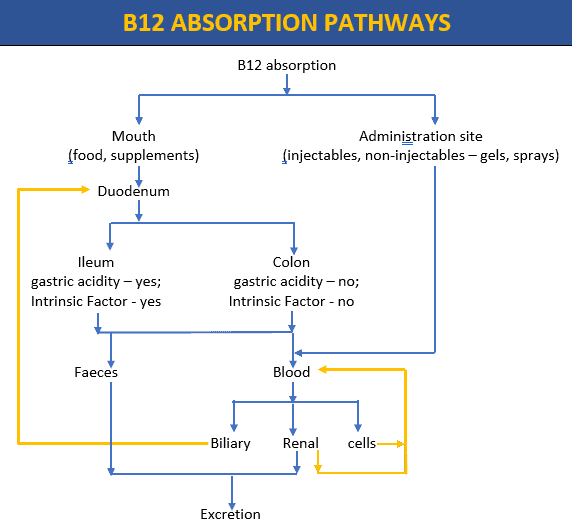
B12’s absorption processes include 2 separate capacity-limited pathways, each with their own site of absorption and mechanism of action.
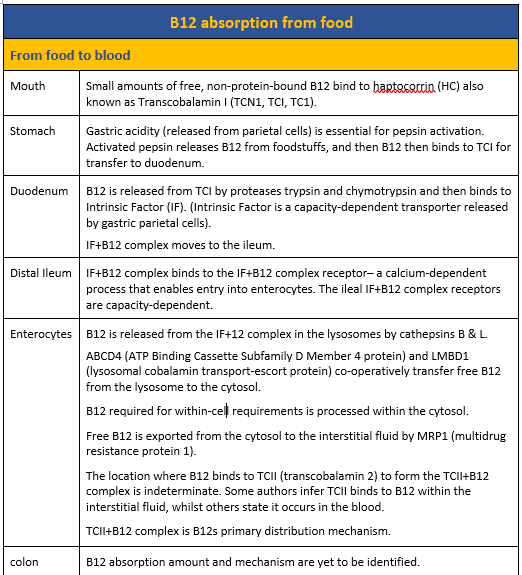
1. Intrinsic Factor to ileum pathway.
Requires 4 factors, being -
- gastric acidity within pH 1-2. Gastric acidity is required to activate pepsin, the protease that releases B12 from foodstuffs;
- receptor capacity. The IF-B12 receptor has a limited number of sites which means B12 absorption is determined by receptor capacity;
- calcium availability. The binding of IF-B12 complex to IF-B12 receptor requires calcium in order to gain entry into the enterocytes.
- absorption refractory period. IF-B12 complex uptake is restricted for ~ 6 hours whilst the IF-B12 receptor density regenerates. For example, consumption of a B12-containing foodstuff at 08:00 means the IF-B12 complex receptors won’t be available again until ~ 14:00.
2. Mouth to colon pathway.
Excessive B12 intake, microbiota-generated B12, and other unabsorbed B12 can be partially absorbed in the colon. This pathway is commonly referred to as “passive diffusion”.
Some early evidence indicates the colonic B12 contribution to B12 status is much more important than currently believed.
“Passive diffusion” seems to be code for unknown transporter(s). The limited “passive” absorption in the colon implies limited capacity of an absorbing mechanism. The body’s tight regulation and many fail-safe options indicate uncontrolled transfer of substances from gut to blood is highly unlikely.
Reabsorption
Renal
Renal resorption of B12 can be quite variable.
High B12 levels, eg post injection, may exceed TCII binding capacity which means renal excretion of the excess.
Biliary
Some B12 is syphoned from the hepatocytes into the biliary system which releases into the duodenum. This pathway means B12 can re-enter the intestinal tract for reabsorption or excretion.
The process by which B12 enters the biliary system is yet to be established.
Elevated B12
B12 levels are rarely monitored once prophylactic maintenance interventions commence.
Some interesting research found that when B12 levels are –
- either low or within range, then uptake is accelerated,
- elevated, then uptake is diminished.
Diagnosing deficiency
B12 availability can be impaired by multiple factors, including prescribed medications such as the acid inhibitors and metformin.
Plasma homocysteine reflects adequacy of B12 status for metabolic function and its concentrations increase once serum B12 < 300 pmol/L.
Professor A. David Smith (VITACOG) defines B12 status as suboptimal < 300 pmol/L.
Clinical concerns
B12 has very well-developed safety mechanisms surrounding its absorption during feast and famine periods. Although the liver is the primary storage site, significant levels of B12 are also stored in the biliary system. In fact, a proportion of B12 is syphoned to the biliary system at every intake.
Regardless of the intestinal pathways utilized, the absorption mechanisms have maximum loads, above which B12 is no longer absorbed. In the ileum, the key receptors also shut down for 4-6 hours once maximum load is exceeded.
The famine protection mechanisms are similarly curious. Reabsorption strategies are a key retention strategy and include both renal and biliary processes.
Some questions that arise include –
What benefit/protection is conferred by absolutely limiting B12 uptake during a “feast” period?
What is the upper B12 limit for absorption cessation via the ileum pathway?
Why don’t we know and fully understand the B12 absorption process in the colon, including its mechanisms and range limits?
What benefit/protection is being conferred by utilizing a system that recycles B12 every food intake episode (via the biliary system)?
What necessitates the storage of a specific water-soluble vitamin in the biliary system?
If prescribed medications alter biliary function, do they also alter the availability of B12? And what are their mechanisms of action?
Do any prescribed medications alter B12 binding to TCII?
Clinical questions
What actions will you initiate when you see someone prescribed a B12 intervention -
- would you recommend monitoring levels and if elevated then reducing either intervention frequency or dose?
- and has ongoing low B12 levels – would you question whether any prescribed medications are inhibiting release of B12 from the ileum or colon?
Conclusions
B12 absorption processes include both feast and famine management strategies.
Bibliography
Bibliography |
|---|
Al-Awami, HM., Raja, A. & Soos, MP. 2023. Physiology, Gastric Intrinsic Factor. [Updated 2023 Jul 17]. In: StatPearls [Internet]. Treasure Island (FL): StatPearls Publishing; 2026 Jan-. Available from: https://www.ncbi.nlm.nih.gov/books/NBK546655/. Accessed 2026-03-08 |
Allen, LH., Miller, JW., de Groot, L., Rosenberg, IH., Smith, AD., Refsum, H. & Raiten, DJ. 2018. Biomarkers of Nutrition for Development (BOND): Vitamin B-12 Review. Journal of Nutrition 148:1995S–2027S. ttps://doi.org/10.1093/jn/nxy201. |
Boachie, J., Adaikalakoteswari, A., Goljan, I., Samavat, J., Cagampang, FR. & Saravanan, P. 2021. Intracellular and Tissue Levels of Vitamin B12 in Hepatocytes Are Modulated by CD320 Receptor and TCN2 Transporter. International Journal of Molecular Science 22(6):3089. https://creativecommons.org/licenses/by/4.0/ |
CLOUD-CLONE CORP.(CCC) https://www.cloud-clone.com/products/RPG794Hu01.html. Accessed 2026-03-08 |
Fedosov, SN., Nexo, E. & Heegaard, CW. 2024. Kinetics of Cellular Cobalamin Uptake and Conversion: Comparison of Aquo/Hydroxocobalamin to Cyanocobalamin. Nutrients 16(3):378. https://doi.org/10.3390/nu16030378 |
Heda, R., Toro, F. & Tombazzi, CR. Physiology, Pepsin. [Updated 2023 May 1]. In: StatPearls [Internet]. Treasure Island (FL): StatPearls Publishing. Accessed 2026-02-25; https://www.ncbi.nlm.nih.gov/books/NBK537005/ |
Kashyap, S., Gowda, P., Pasanna, RM., Sivadas, A., Sachdev, HS., Kurpad, AV. & Devi, S. 2024 The Oral Bioavailability of Vitamin B12 at Different Doses in Healthy Indian Adults. Nutrients 16:4157. https://doi.org/10.3390/nu16234157 |
Kuldyushev, NA., Simonenko, SY., Goreninskii, SI., Pallaeva, TN., Zamyatnin, AA Jr. & Parodi, A. 2025. From Nutrient to Nanocarrier: The Multifaceted Role of Vitamin B12 in Drug Delivery. International Journal of Molecular Science 26(11):5119. https://doi.org/10.3390/ijms26115119 |
Miller, JW. 2018. Proton Pump Inhibitors, H2-Receptor Antagonists, Metformin, and Vitamin B-12 Deficiency: Clinical Implications. Advances in Nutrition 9(4):511S-518S. https://doi.org/10.1093/advances/nmy023 |
Moravcová, M., Siatka, T., Krčmová, LK., Matoušová, K. & Mladěnka, P. 2024. Biological properties of vitamin B12. Nutrition Research Reviews 38(1):338-370. https://doi.org/10.1017/S0954422424000210 |
Mucha, P., Kus, F., Cysewski, D., Smolenski, RT. & Tomczyk, M. 2024. Vitamin B12 Metabolism: A Network of Multi-Protein Mediated Processes. International Journal of Molecular Science 25(15):8021 https://doi.org/10.3390/ijms25158021 |
O'Leary, F. & Samman, S. 2010. Vitamin B12 in health and disease. Nutrients 2(3):299-316. https://doi.org/10.3390/nu2030299 |
Quadros, EV., Regec, AL., Khan, KMF., Quadros, E. & Rothenberg, SP. 1999. Transcobalamin II synthesized in the intestinal villi facilitates transfer of cobalamin to the portal blood. American Journal of Physiology-Gastrointestinal and Liver Physiology 277:1, G161-G166. https://doi.org/10.1152/ajpgi.1999.277.1.G161 |
Smith, AD. 2016. Hippocampus as a mediator of the role of vitamin B-12 in memory. American Journal of Clinical Nutrition 103:959–60. |
Smith, AD., Warren, MJ. & Refsum, H. 2018. Chapter six – vitamin B12. Advances in Food and Nutrition Research 83:215-279. https://doi.org/10.1016/bs.afnr.2017.11.005 |
Sobczyńska-Malefora, A., Delvin, E., McCaddon, A., Ahmadi, K. R., & Harrington, D. J. 2021. Vitamin B12 status in health and disease: a critical review. Diagnosis of deficiency and insufficiency – clinical and laboratory pitfalls. Critical Reviews in Clinical Laboratory Sciences 58(6):399–429. https://doi.org/10.1080/10408363.2021.1885339 |
Editor-in-Chief: Anthony J. Busti, MD, PharmD, FNLA, FAHA Reviewer: Jon D. Herrington, PharmD, BCPS, BCOP The Mechanism of Absorption of Vitamin B12 (cobalamin) in the GI Tract https://www.ebmconsult.com/articles/vitamin-b12-absorption-mechanism-intestine-intrinsic-factor. Accessed 2026-02-11 |
Vitamin B12. 2025. National Institutes of Health. Accessed 2026-02-03 |
Researched and written by the author.
Cite: Coleman, Y. 2026. B12 absorption. MedNut Mail https://medicationsandnutrition.com/b12-absorption/ Accessed (date)
Please read this as it is important …
The information in this article is provided to support Health Professionals. It is not an exhaustive protocol and Health Professionals are advised that adequate professional supervision is accessed to ensure that Duty of Care obligations with respect to safe administration of medicines is met for each consumer.