B12 and acid inhibitors are a likely cause for concern. Do acid inhibitors impair B12 absorption and what are the best B12 management options?
Introduction
B12 requires gastric acidity for absorption, and acid inhibitors inhibit gastric acid availability.
B12
Absorption of orally-consumed B12 is a surprisingly complex process that includes 2 separate capacity-limited pathways and 2 sites of absorption.
1. Intrinsic Factor to ileum pathway.
Utilizes gastric acidity and Intrinsic Factor to facilitate release of B12 from foodstuffs and its absorption.
2. Mouth to colon pathway.
Excessive B12 intake, available microbiota-generated B12, and other unabsorbed B12 can be partially absorbed in the colon. This pathway is commonly referred to as “passive diffusion”.
Acid inhibitors
Acid inhibitors reduce the amount of acidity released from the gastric parietal cells into the stomach, and include -
H2 antagonists (H2As). Block the histamine receptors. Increase gastric pH to a median of about 2-3. Can maintain intragastric pH > 4 for 4 hours.
Proton pump inhibitors (PPIs). Inhibit the proton pumps. Increase gastric pH to about 4-6. Can maintain intragastric pH > 4 for 15-22 hours.
Potassium-competitive acid blockers (P-CABs). Bind to proton pumps in a K+-competitive manner. Early evidence indicates they maintain a pH > 4 for longer than PPIs.
Comments about PPIs in this post are deemed relevant to P-CABs because of their many similarities. However, there is currently no specific evidence likely due to their recent formulation.
B12 and acid inhibitors
The primary source of B12 is dietary ie from foodstuffs that require gastric acidity and/or Intrinsic Factor to enable absorption. Other sources of B12 do not require gastric acidity and/or Intrinsic Factor to enable their absorption.
Acid inhibitors suppress gastric acid production and consequently impair B12 absorption from foodstuffs. However, they do not impair release of Intrinsic Factor from gastric parietal cells.
Mechanisms of action
The primary mechanisms of action for acid inhibitors to impair B12 absorption are multifactorial.
1. Decreased gastric acidity.
B12 essentially requires a gastric acidity < pH 2 for its release from foodstuffs. If the pH ranges between 2-4 then the release of B12 is very limited.
2. Possible inhibition/downregulation of MRP1.
MRP1 is essential for B12 efflux from cells to blood. Early experimental evidence indicates PPIs can inhibit/downregulate MRP1. Currently the evidence is non-existent as to whether they inhibit/downregulate MRP1 in the brush border enterocytes.
3. Inhibition of other transporters.
Includes transcobalamins, ABCD4, LMBD1. May indirectly inhibit these transporters via decreased availability of gastric acidity.
4. Potential inhibition of calcium availability.
Calcium is required for B12 uptake in the brush border enterocytes. Calcium availability is dependent upon the type of calcium compound. Compounds such as calcium carbonate require a source of acid (gastric or dietary) for its release whilst others such as calcium citrate do not.
The research findings on whether acid inhibitors impact B12 status is equivocal for several reasons, including –
B12 interventions
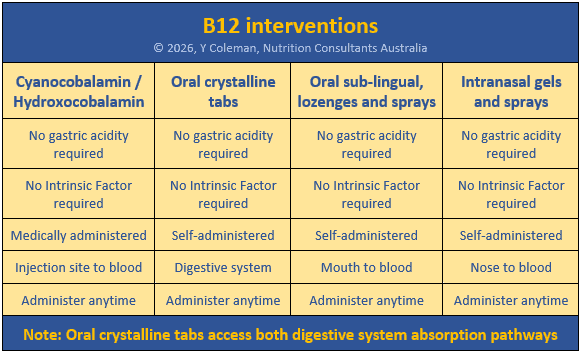
B12 deficiency is currently, typically managed with regular (monthly, quarterly) B12 injections.
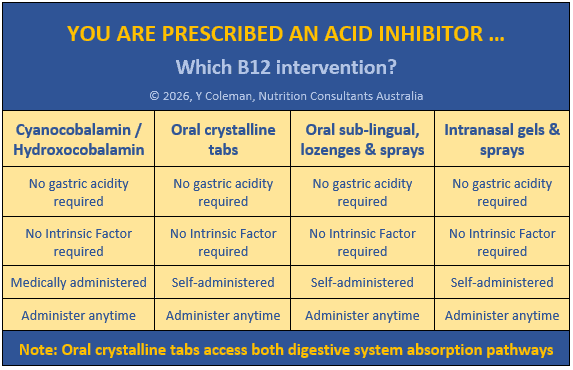
A range of non-injectable products are now available that do not require gastric acidity for absorption. Further, these products can be both self-administered, and administered on a daily basis. Daily administration advantages include lower doses and therefore minimised peaks and troughs.
Clinical concerns
If MRP1 is confirmed to be inhibited/downregulated then B12 won’t be effluxed from the enterocytes into the bloodstream. This means people could have adequate B12 intake concurrently with blood tests indicating low levels.
Clinical questions
When you see someone prescribed both B12 interventions and an acid inhibitor, will you -
- recommend annual monitoring of B12 status?
- suggest a choice of non-gastric-acid-requiring products if B12 is low or at low end of normal range?
Conclusions
B12 and acid inhibitors are a common, concerning, combination as B12 absorption is compromised due to interference with several factors.
Researched and written by the author.
Cite: Coleman, Y. 2026. B12 and acid inhibitors. MedNut Mail https://medicationsandnutrition.com/b12-and-acid-inhibitors/ Accessed (date)
Bibliography
Bibliography |
|---|
Allen, LH., Miller, JW., de Groot, L., Rosenberg, IH., Smith, AD., Refsum, H. & Raiten, DJ. 2018. Biomarkers of Nutrition for Development (BOND): Vitamin B-12 Review. Journal of Nutrition 148:1995S–2027S. ttps://doi.org/10.1093/jn/nxy201. |
Heda, R., Toro, F. & Tombazzi, CR. Physiology, Pepsin. [Updated 2023 May 1]. In: StatPearls [Internet]. Treasure Island (FL): StatPearls Publishing. Accessed 2026-02-25; https://www.ncbi.nlm.nih.gov/books/NBK537005/ |
Kashyap, S., Gowda, P., Pasanna, RM., Sivadas, A., Sachdev, HS., Kurpad, AV. & Devi, S. 2024 The Oral Bioavailability of Vitamin B12 at Different Doses in Healthy Indian Adults. Nutrients 16:4157. https://doi.org/10.3390/nu16234157 |
Kurpad, AV., Pasanna, RM., Hegde, SG., Patil, M., Mukhopadhyay, A., Sachdev, HS., Bhat, KG., Sivadas, A, & Devi, S. 2023. Bioavailability and daily requirement of vitamin B12 in adult humans: an observational study of its colonic absorption and daily excretion as measured by [13C]-cyanocobalamin kinetics. The American Journal of Clinical Nutrition 118(6):1214-1223. https://ajcn.nutrition.org/https://doi.org/10.1016/j.ajcnut.2023.08.020 |
Miller, JW. 2018. Proton Pump Inhibitors, H2-Receptor Antagonists, Metformin, and Vitamin B-12 Deficiency: Clinical Implications. Advances in Nutrition 9(4):511S-518S. https://doi.org/10.1093/advances/nmy023 |
Moravcová, M., Siatka, T., Krčmová, LK., Matoušová, K. & Mladěnka, P. 2024. Biological properties of vitamin B12. Nutrition Research Reviews 38(1):338-370. https://doi.org/10.1017/S0954422424000210 |
Obeid, R., Geisel, J., Pietrzik, K. & Andres, E. 2025. A Framework to Guide Defining an Upper Threshold of Crystalline Vitamin B12 in Foods and Food Supplements. Current Nutrition Reports 14(1):32. https://doi.org/10.1007/s13668-025-00622-7 |
Parnham, O. & Patient, W. 2025. Association Between Long-Term Proton Pump Inhibitor Therapy and Vitamin B12 Status: A Systematic Review and Meta-Analysis. Cureus 17(8):e90038. doi: 10.7759/cureus.90038 |
Sobczyńska-Malefora, A., Delvin, E., McCaddon, A., Ahmadi, K. R., & Harrington, D. J. 2021. Vitamin B12 status in health and disease: a critical review. Diagnosis of deficiency and insufficiency – clinical and laboratory pitfalls. Critical Reviews in Clinical Laboratory Sciences, 58(6), 399–429. https://doi.org/10.1080/10408363.2021.1885339 |
Please read this as it is important …
The information in this article is provided to support Health Professionals. It is not an exhaustive protocol and Health Professionals are advised that adequate professional supervision is accessed to ensure that Duty of Care obligations with respect to safe administration of medicines is met for each consumer.