Takeaway
Altered glycaemic states actively alter cytochrome P450s expression and function.
Cytochrome P450s can indirectly alter glycaemic status.
Not all drugs are metabolized by the cytochrome P450s.
Cytochrome P450s are important in Phase 1 drug metabolism as they modify compounds to include a more water-soluble component. This modification enables either their excretion or Phase II metabolism.
The focus of this post is on the interactions between cytochrome P450s and glycaemic status.
Rather than referring to “xenobiotics, including prescribed medications”, I shall use “prescribed medications” or “drugs” interchangeably as a global alternative.
How Cytochrome P450s Alter Glycaemia
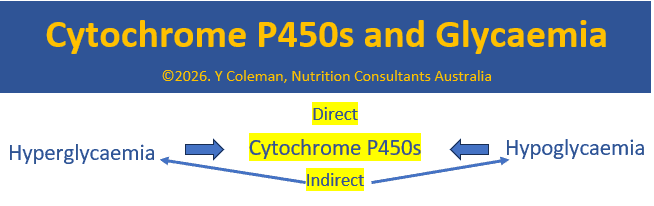
In physiological systems, including cytochrome P450 metabolic pathway, the interactions can be either direct or indirect -
Direct interactions: Cytochrome P450 isozymes do not directly participate in glucose metabolism.
Indirect interactions: Evidence is steadily increasing that cytochrome P450s can alter glycaemic status by altering drug availability.
Example 1 - inhibition: Glibenclamide is a CYP2C9 substrate; its unchanged form is the active form. If an inhibitor is prescribed then glibenclamide’s effectiveness is increased thus increasing the risk of hypoglycaemia.
Example 2 - induction: Causes increased rate of metabolism of the substrate drug which ultimately results in decreased therapeutic effect.
How Hyperglycaemia Alters Cytochrome 450s
Hyperglycaemia alters cytochrome P450s expression and activity indirectly via a variety of mechanisms, some of which are briefly outlined.
Cytokines
Chronic hyperglycaemia enhances the sustained activation and production of pro-inflammatory cytokines such as IL-6 and TNF-α. CYP1A2, CYP2C9, and CYP3A4 are downregulated by chronic low-grade inflammation.
Epigenetics
Hyperglycaemia induces epigenetic changes that form metabolic memory. Metabolic memory means that even after glycaemic status normalizes, the gene expression profile of metabolizing isozymes remains altered ie cannot be reversed. Consequently, altered drug metabolism and the risk of adverse drug reactions continue despite improved glycaemia.
Albumin Availability
Albumin is the body’s primary carrier of substances including drugs, in the blood. Ultimately, reduced albumin availability means -
- reduced levels of drugs are available for cytochrome P450s metabolism and therefore their effectiveness is limited,
- the unmetabolized component of drugs increases the risks of adverse reactions.
Increased Urinary Albumin Excretion (UAE)
Hyperglycaemia is the primary trigger for renal endothelial dysfunction. Increased UAE is a marker of renal endothelial dysfunction in early-stage Type 2 Diabetes.
Glycated Albumin
Glycation is the binding of a sugar to a protein such as albumin, during hyperglycemia. Albumin availability is reduced and consequently so is the number drugs that can be carried. Hyperglycaemia increases the rate and extent of albumin glycation.
MedNut Mail post. 2025. Albumin and Glucose. https://medicationsandnutrition.com/albumin-and-glucose/
The Zinc Switch
Albumin production is dependent upon insulin’s regulation of albumin’s gene expression. Insulin activation is dependent upon albumin accepting its cleaved zincs (from released insulin hexamers).
MedNut Mail post. 2025. The Zinc Switch. https://medicationsandnutrition.com/the-zinc-switch/
Type 2 Diabetes
The impacts of Type 2 Diabetes on the activity levels of CYP1A2, CYP2B6, CYP2C9, CYP2C19, CYP2D6, CYP2E1, and CYP3A4/5 can be -
Decreased: CYP2C19 (46%), CYP2B6 (45%), CYP3A (38%), CYP2C9.
Unchanged: CYP2D6, CYP2E1.
Equivocal: CYP1A2. Activity can be dependent on glycemic levels and may be induced by poor glycemic control.
How Hypoglycaemia Alters Cytochrome 450s
Cytokines
Cytokine production depends mainly on blood glucose levels. Hypoglycaemia downregulates cytokine production likely in a glucose concentration-dependent manner.
Fasting
Short-term fasting influences CYP1A2, CYP2C9 and CYP2D6 drug metabolism by altering systemic clearance. The fasting effect is cytochrome P450 isozyme-specific.
Other Mechanisms
NADPH (Nicotinamide Adenine Dinucleotide Phosphate)
NADPH is the activated form of niacin. It is important in both cytochrome P450 function and insulin release from pancreatic beta-cells.
Insulin resistance means cells are unable to, or have limited capacity to process glucose through NADPH-generating pathways. Consequently, NADPH availability is reduced, which means cytochrome P450s-mediated phase I metabolism is either reduced or stopped.
Insulin resistance
Peripheral insulin resistance causes beta-cells in the pancreas to increase insulin production. Chronic overproduction of insulin causes the generation of reactive oxygen species in the beta-cells which then causes endoplasmic reticulum stress. Sustained endoplasmic reticulum stress ultimately results in cytochrome P450s dysfunction and cell death.
How to Integrate Cytochrome P450s into Clinical Assessments
We need to know ALL the substrates, inhibitors and inducers being consumed ie prescribed medications, nutrients, foodstuffs, and food components.
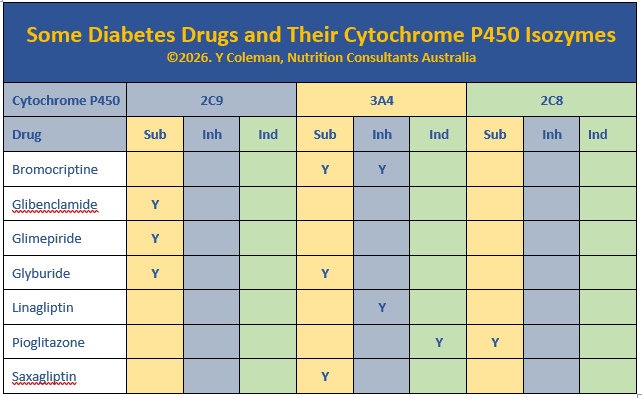
This table identifies the Oral Hypoglycaemic Agents that are metabolized by cytochrome P450s. It also includes both their specific cytochrome isozyme(s), and their function ie whether they are metabolized (substrates), inhibited or induced.
We then need to -
- identify the other prescribed drugs that inhibit or induce these OHA drugs,
- ascertain whether they are contributing to altered glycaemic status.
This information may also modify some of the “dietary non-compliant” blame-labelling that is ascribed to those with sustained poorly-controlled glycaemic status. Hopefully this information will acknowledge an iatrogenic (healthcare-induced) component is contributing to this chronic poor glycaemic control.
Useful Resources
Flockhart Table
This useful resource identifies whether a drug is a substrate, inhibitor, or inducer of cytochrome P450s. Sadly, it has not been updated since 2021.
Drug Interactions Flockhart Table. https://drug-interactions.medicine.iu.edu/main-table
Systems Biology
This paper summarizes relevant systems succinctly.
Interactions Between Hyperglycaemia, Drug Metabolism, and Toxicity Profiles: A Systems Biology Review. 2026. https://doi.org/10.59298/NIJSES/2026/71.713
Clinical Concerns
Chronic altered glycaemia means altered cytochrome P450s metabolism and therefore altered availability of prescribed medications. How do we manage -
- those whom we know have chronic hyperglycaemia such as those prescribed prednisolone?
- rebellious teenagers?
- those who fast either episodically (eg for clinical tests or interventions), or regularly (eg philosophical practice)?
Clinical Questions
Will you include the impacts of cytochrome P450 on glycaemic control as a standard component in your clinical assessments?
Conclusions
Cytochrome P450s inclusion in clinical assessments adds an extra layer of complexity, and potential benefit, to clinical assessments.
Bibliography
Bukowska, B., Grzegorowska, A., Szczerkowska-Majchrzak, E., Bukowski, K., Kadac-Czapska, K., Grembecka, M. & Broncel, M. 2023. Hazardous Interactions Between Food, Herbs, and Drugs in the First Stage of Biotransformation: Case Reports of Adverse Drug Interactions in Humans. International Journal of Molecular Science 26:5188. https://doi.org/10.3390/ijms26115188
Bwanbale Geoffrey David. 2026. Interactions Between Hyperglycaemia, Drug Metabolism, and Toxicity Profiles: A Systems Biology Review. Newport International Journal Of Scientific And Experimental Sciences 7(1):7-13. https://doi.org/10.59298/NIJSES/2026/71.713
Cannito, S., Giardino, I., D’Apolito, M., Ranaldi, A., Scaltrito, F., Pettoello-Mantovani, M. & Piscazzi, A. 2025. From Metabolic to Epigenetic Memory: The Impact of Hyperglycemia-Induced Epigenetic Signature on Kidney Disease Progression and Complications. Genes 16(12):1442. https://doi.org/10.3390/genes16121442
Darakjian, L., Deodhar, M., Turgeon, J. & Michaud, V. 2021. Chronic Inflammatory Status Observed in Patients with Type 2 Diabetes Induces Modulation of Cytochrome P450 Expression and Activity. International Journal of Molecular Science 22(9):4967. doi: 10.3390/ijms22094967. PMID: 34067027; PMCID: PMC8124164.
dos Santos, LRB. & Fleming, I. 2020. Role of cytochrome P450-derived, polyunsaturated fatty acid mediators in diabetes and the metabolic syndrome. Prostaglandins & Other Lipid Mediators 148:106407. https://doi.org/10.1016/j.prostaglandins.2019.106407
GLYBURIDE. https://www.genome.jp/. Accessed 2026
Esteves, F., Rueff, J. & Kranendonk, M. 2021. The Central Role of Cytochrome P450 in Xenobiotic Metabolism—A Brief Review on a Fascinating Isozyme Family. Journal of Xenobiotics 11:94–114. https://doi.org/10.3390/jox11030007
Hirai, T., Morikawa, Y., Onishi R, Nakatani, Y., Nishikawa, K., Inoue, T. & Iwamoto, T. 2023. Impact of glycaemic control and CYP3A5 polymorphisms on tacrolimus trough concentrations after adult kidney transplantation. British Journal of Clinical Pharmacology 89(6):1852-1861. doi:10.1111/bcp.15662
Kwon, D., Kim, SM. & Correia, MA. 2020. Cytochrome P450 endoplasmic reticulum-associated degradation (ERAD): therapeutic and pathophysiological implications. Acta Pharmaceutica Sinica B 10(1):42-60. doi: 10.1016/j.apsb.2019.11.002. Epub 2019 Nov 8. PMID: 31993306; PMCID: PMC6976991.
Lammers, LA., Achterbergh, R., van Schaik, RHN., Romijn JA, & Mathôt, RAA. 2017. Effect of Short-Term Fasting on Systemic Cytochrome P450-Mediated Drug Metabolism in Healthy Subjects: A Randomized, Controlled, Crossover Study Using a Cocktail Approach. Clinical Pharmacokinetics 56(10):1231-1244. doi: 10.1007/s40262-017-0515-7. PMID: 28229374; PMCID: PMC5591816.
Moon, DO. 2023. NADPH Dynamics: Linking Insulin Resistance and β-Cells Ferroptosis in Diabetes Mellitus. International Journal of Molecular Science 25(1):342. doi: 10.3390/ijms25010342. PMID: 38203517; PMCID: PMC10779351.
Mrudula, G., Caroline, P., Kingsley, T. & Jaiswal, R. 2017. A Review on Drug Interactions in Oral Hypoglycaemic Drugs by Mechanism of Cytochrome P450 Enzyme Inhibition. Journal of Pharmaceutical Research 16(2):154. DOI:10.18579/jpcrkc/2017/16/2/116434. https://jopcr.com/
Nikolaidou, B., Gkaliagkousi, E., Anyfanti, P., Gavriilaki, E., Lazaridis, A., Triantafyllou, A., Zografou, I. & Douma, S. 2020. The impact of hyperglycemia on urinary albumin excretion in recent onset diabetes mellitus type II. BMC Nephrology 21(1):119. doi: 10.1186/s12882-020-01774-0. PMID: 32252655; PMCID: PMC7137425.
Rondeau, P. & Bourdon, E. 2011. The glycation of albumin: structural and functional impacts. Biochimie 93(4):645-58. doi: 10.1016/j.biochi.2010.12.003. Epub 2010 Dec 16. PMID: 21167901.
Sibiya, N., Onyekwuluje, C., Kuretu, A., Ayodele, O., Ngcobo, N., Ngubane, P. & Khathi, A. 2026. Type 2 diabetes mellitus as a state of altered drug pharmacokinetic-pharmacodynamic parameters: an update on recent developments and clinical implications. Therapeutic Advances in Endocrinology and Metabolism 17:1-20. doi:10.1177/20420188241305021
Tateishi, H., Miyazu, D., Kurinami, M., Ieiri, I., Hirakawa, M., &Watanabe. H. 2021. Hypoglycaemia possibly caused by CYP2C9-mediated drug interaction in combination with bucolome: a case report. Journal of Pharm Health Care & Sciences 7(1):39. doi: 10.1186/s40780-021-00221-y. PMID: 34727989; PMCID: PMC8564963.
Tomlinson, B. & Li, Y-H. 2023. What is the impact of type 2 diabetes mellitus on CYP450 metabolic activities? Expert Opinion on Drug Metabolism & Toxicology 19:12, 867-870. DOI: 10.1080/17425255.2023.2288246
Cite: Coleman, Y. 2026. Cytochrome P450a and Glycaemia. MedNut Mail https://medicationsandnutrition.com/cytochrome-p450s-and-glycaemia/ Accessed (date)
Cytochrome P450s and Glycaemia
Professional Notice
The information in this article is designed to support healthcare professionals. It is not an exhaustive clinical protocol. Healthcare professionals are advised to maintain adequate professional supervision to ensure Duty of Care obligations with respect to safe administration of medicines is met for each individual consumer.
Core Philosophy
Whilst medications have profoundly improved global health outcomes, they typically also introduce nutritional challenges. By proactively identifying and addressing these nutritional harms, we can bridge the gap towards achieving better health outcomes.