Takeaway
Cytochrome P450 isozymes are important in xenobiotic clearance.
Play essential roles in endogenous biosynthesis.
Convert water-repelling compounds into easily excretable molecules.
Cytochrome P450 isozymes are important in many nutrition and xenobiotic metabolic processes. They primarily convert endogenous (from within body) and exogenous (from outside body) lipid-soluble compounds into easily-excreted water-soluble metabolites.
Regulatory processes require interactions with defined CYP P450s isozymes to be evaluated in the drug discovery process. The FDA-defined list of cytochromes includes CYP1A2, CYP2B6, CYP2C8, CYP2C9, CYP2C19, CYP2D6, CYP3A4 + CYP2E1.
Cytochromes are referred to interchangeably as enzymes, isoenzymes, or isozymes. Isozymes are enzymes with either different amino acid sequences, or different genes, that catalyze the same biochemical reactions.
This post is a general overview of cytochrome P450 isozymes and their global functions and mechanisms of action.
Cytochrome P450 Isozymes (CYP P450s)
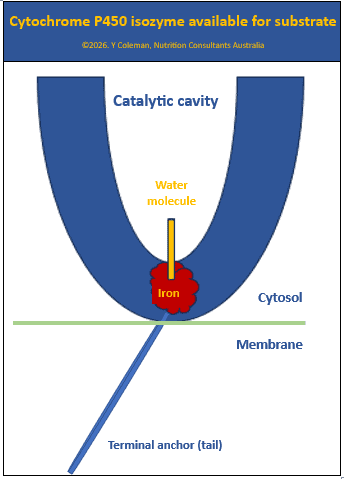
CYP P450 isozymes are haemoproteins ie iron-containing, that are also known as monooxygenases, or mixed-function oxidases.
Locations
These isozymes are distributed throughout the body, and primarily located in the small intestine, liver, and kidneys.
Within cells, CYP P450s are typically located in the –
- endoplasmic reticulum membrane. These isozymes primarily catalyze exogenous compounds such as drugs.
- inner mitochondrial membrane. These isozymes primarily catalyze endogenous metabolic compounds such as cholesterol.
Functions
Processes in which they are essential include -
- Metabolic. Includes caffeine, cofactors, unsaturated fatty acids, xenobiotics, including drugs, fat-soluble vitamins, Vitamin D, retinoids.
- Regulatory. Includes fatty acids.
- Bioynthesis. Includes steroids, hormones, eicosanoids, cholesterol, bile acid.
Their activity can be altered by factors including diet, nutrients, gut microbiota, age, gender, genetic polymorphisms, xenobiotics, disease and allostery. Allostery is induced structural change that alters functionality.
Electron donors
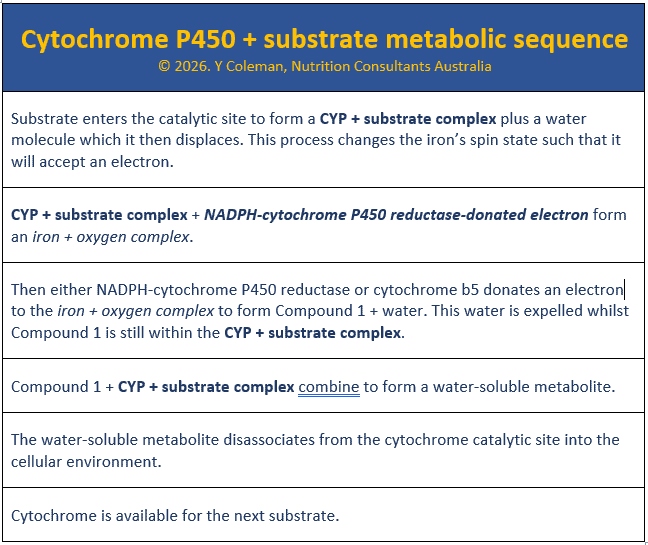
The CYP P450 metabolic process requires the addition of 2 electrons in a 2-step process.
- NADPH-cytochrome P450 reductase (CPR). Essential for the transfer of the first electron in the 2-step process.
- Cytochrome-b5 reductase (CYB5R). A flavoprotein that typically transfers the second electron in the 2-step process.
Cytochrome b5 is the preferred second electron donor for CYP1A2, CYP2A6, CYP2B6, CYP2C8, CYP2C9, CYP2C19, CYP3A4, CYP2E1. CYP2D6 interaction with Cytochrome b5 is weak.
Mechanisms of Action
The cytochrome P450 isozymes can be substrates, inhibitors, or inducers.
1. Substrates
Substrates are typically compounds metabolized by the isozyme. After the substrate is metabolized, the isozyme is available for the next substrate.
Example. Caffeine is a CYP1A2 substrate.
2. Inhibitors
Inhibitors are typically compounds that stop the isozymes from functioning.
- Reversible inhibition means the isozyme is not destroyed in the metabolic process,
- irreversible inhibition (mechanism-based) means the isozyme is destroyed and must be resynthesized.
Slowing or inhibiting metabolism increases the risk of accumulation, toxicity, and adverse effects. It also activates prodrugs.
Inhibition can be within minutes, hours or days, and recovery can be within hours or days.
Example. Grapefruit juice inhibits CYP3A4 function (irreversible).
3. Inducers
Inducers are compounds that increase the actual number of isozymes and therefore indirectly increase the isozyme’s rate of metabolism. They do not directly increase the isozyme’s rate of metabolism.
Induction and recovery can be within hours or days.
Example. Ethanol is a CYP2E1 inducer.
Cytochromes in the Absorption-Metabolism Process
Digestion is the progressive breakdown of orally-consumed items to their basic components. These components are typically either hydrophilic (water attracting), hydrophobic (water-repelling), lipophilic (fat attracting), lipophobic (fat repelling).
Lipophilic substances typically bind to micelles for transport to enterocytes in the intestinal brush border. (Micelles are structures that expedite the transport of poorly water-soluble agents). Membrane transporters then collect and transfer the lipophiles (fat-based) into cells where they locate their relevant cytochrome P450 isozymes. After metabolism they are ejected from the cell, typically for excretion.
Apart from some CYP3A4 exceptions, hydrophilic substances are not metabolized by cytochrome P450 isozymes. CYP3A4 can metabolize some hydrophilic compounds that are diverse in size and chemical structure.
Conclusions
Cytochrome P450 isozymes are essential in metabolic, regulatory, and biosynthesis processes that include the excretion of fat-soluble compounds.
Bibliography
Stouras, I., Papaioannou, TG., Tsioufis, K., Eliopoulos, AG. & Sanoudou, D. 2022. The Challenge and Importance of Integrating Drug-Nutrient-Genome Interactions in Personalized Cardiovascular Healthcare. Journal of Personalized Medicine 12(4):513. https://doi.org/10.3390/jpm12040513. PMID: 35455629; PMCID: PMC9033008.
Esteves, F., Rueff, J. & Kranendonk, M. 2021. The Central Role of Cytochrome P450 in Xenobiotic Metabolism—A Brief Review on a Fascinating Enzyme Family. Journal of Xenobiotics 11:94–114. https://doi.org/10.3390/jox11030007
Patel, T., Rahimi, N. & Cassagnol, M. 2026. Biochemistry, Cytochrome P450. [Updated 2026 Jan 10]. In: StatPearls [Internet]. Treasure Island (FL): StatPearls Publishing; 2026 Jan-. Available from: https://www.ncbi.nlm.nih.gov/books/NBK557698/
Relats, C., Sadeghi-Reeves, L., Zbären, E. & Jenzer, H. 2018. The role of food-drug-cytochrome P450 interactions in breast cancer. Medical Science Review 5:25–34. doi: 10.12659/MSRev.9115285:25–34. doi: 10.12659/MSRev.911528
Bukowska, B., Grzegorowska, A., Szczerkowska-Majchrzak, E., Bukowski, K., Kadac-Czapska, K., Grembecka, M. & Broncel, M. 2025. Hazardous Interactions Between Food, Herbs, and Drugs in the First Stage of Biotransformation: Case Reports of Adverse Drug Interactions in Humans. International Journal of Molecular Science 26:5188. https://doi.org/10.3390/ijms26115188
Flockhart, DA., Thacker, D., McDonald, C. & Desta, Z. 2021. The flockhart cytochrome p450 drug-drug interaction table. Division of Clinical Pharmacology, Indiana University School of Medicine (Updated 2021). https://druginteractions.medicine.iu.edu/. Accessed 2026.
US Food and Drug Administration. Drug development and drug interactions: Table of substrates, inhibitors and inducers. https://www.fda.gov/drugs/drug-interactions-labeling/drug-development-and-drug-interactions-table-substrates-inhibitors-and-inducers (Accessed 2026).
P450Reaction database v 2.0. https://www.cellknowledge.com.cn/p450rdb_v2/. Accessed 2026.
Zanger, UM. 2020. P450 Monooxygenase System. In: Offermanns, S., Rosenthal, W. (eds) Encyclopedia of Molecular Pharmacology. Springer, Cham. https://doi.org/10.1007/978-3-030-21573-6_111-1
Urban, P., Perret, A. & Pompon, D. 2025. Redox partner exchanges between spatially confined complexes control the coupling effect of cytochrome b5 on P450 CYP3A4. Scientific Reports 15:24584 (2025). https://doi.org/10.1038/s41598-025-09060-5
Bart, AG. & Scott, EE. 2017. Structural and functional effects of cytochrome b5 interactions with human cytochrome P450 enzymes. Journal of Biological Chemistry 292(51):20818-20833. doi: 10.1074/jbc.RA117.000220. PMID: 29079577; PMCID: PMC5743060.
Xia, S. & Hirao, H. 2025. Recent Advances in Elucidating the Mechanism of the NADPH–Cytochrome P450 Reductase-Mediated Electron Transfer Cycle: Experimental and Computational Perspectives. Molecules 30:3733. https://doi.org/10.3390/molecules30183733
Uniport database. https://www.uniprot.org/. Accessed 2026
Peng, HM. & Auchus RJ. 2013. The action of cytochrome b(5) on CYP2E1 and CYP2C19 activities requires anionic residues D58 and D65. Biochemistry 52(1):210-20. doi: 10.1021/bi301384n. Epub 2012 Dec 17. Erratum in: Biochemistry. 2014 Jan 28;53(3):610. PMID: 23193974; PMCID: PMC3596112.
Gómez-Tabales, J., García-Martín, E., Agúndez, JAG. & Gutierrez‑Merino, C. 2020. Modulation of CYP2C9 activity and hydrogen peroxide production by cytochrome b5. Scientific Reports 10:15571. https://doi.org/10.1038/s41598-020-72284-0
Sevrioukova, IF. & Poulos, TL. 2013. Understanding the mechanism of cytochrome P450 3A4: recent advances and remaining problems. Dalton Transactions 42(9):3116-26. doi: 10.1039/c2dt31833d. PMID: 23018626; PMCID: PMC3787833.
Hernández-Lorca, M., Timón, IM., Ballester, P., Henarejos-Escudero, P., García-Muñoz, AM., Victoria-Montesinos, D. & Barcina-Pérez, P. 2025. Dietary Modulation of CYP3A4 and Its Impact on Statins and Antidiabetic Drugs: A Narrative Review. Pharmaceuticals 18:1351. https://doi.org/10.3390/ph18091351
Cite: Coleman, Y. 2026. B12 absorption. MedNut Mail https://medicationsandnutrition.com/about-cytochrome-p450-isozymes/ Accessed (date)
About Cytochrome P450 Isozymes
Professional Notice
The information in this article is designed to support healthcare professionals. It is not an exhaustive clinical protocol. Healthcare professionals are advised to maintain adequate professional supervision to ensure Duty of Care obligations with respect to safe administration of medicines is met for each individual consumer.
Core Philosophy
Whilst medications have profoundly improved global health outcomes, they typically also introduce nutritional challenges. By proactively identifying and addressing these nutritional harms, we can bridge the gap towards achieving better health outcomes.