Food security and pharmaceuticals are an unlikely association. Pharmaceuticals are perceived as beneficial “make us better” whilst their impacts on food and water security are typically not considered.
Food and water security is complete self-sufficiency in (staple) food production that is not produced on contaminated land and/or water. Inadequate optimal nutrient intake results in mal-nutrition.
For the purposes of this post the term “food security” will include both food and water security.
Pharmaceutical impacts on food security
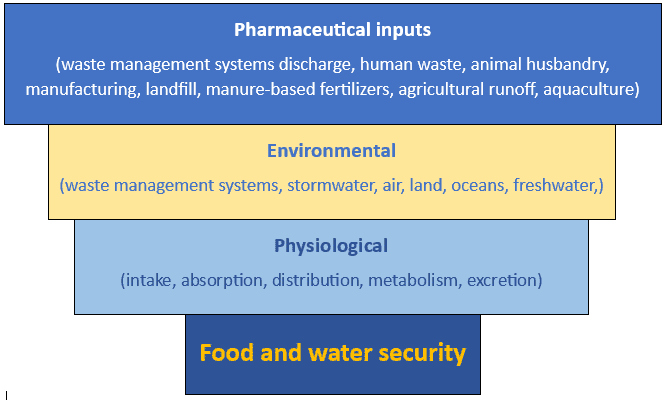
Drug-related impacts on food security are multifaceted and include -
- physiological – altered nutritional intake, absorption, distribution, metabolism, excretion;
- environmental – as contaminants that enter/re-enter the food chain.
The pharmaceutical sector is currently not accountable for their direct and indirect environmental harms ie no environmental accountability.
Impacts on food security
Pharmaceuticals affect ecosystems and thus food security, globally. Their widespread use and resistance to degradation results in persistence, accumulation and limited biodegradability.
Waste Management Systems (WMS) include sewerage, anaerobic septic, aerobic vermicomposting, pits, and “behind a bush” models. They are all ill-equipped to remove substances such as pharmaceuticals with their complex structures, low biodegradability, and low concentrations.
Pharmaceutical industry emissions (volatile organic compounds) evaporate into the air, contributing to the formation of smog and ground-level ozone.
Evidence indicates that with anaerobic septic system models, pharmaceuticals leach into, and accumulate in, the surrounding land and water systems.
Vermicomposting systems consistently moderate many pharmaceutical impacts, including the spread of antibiotic resistance and Antibiotic Resistance Genes (ARG).
Food security and pharmaceuticals are an unlikely association. Pharmaceuticals are perceived as beneficial “make us better” whilst their impacts on food and water security are typically not considered.
Food and water security is complete self-sufficiency in (staple) food production that is not produced on contaminated land and/or water. Inadequate optimal nutrient intake results in mal-nutrition.
For the purposes of this post the term “food security” will include both food and water security.

Physiological harm
Currently identified harms include genetic changes, physical abnormalities, altered metabolic processes, altered immunological factors, and many others.
The negative impacts of pharmaceuticals on nutritional health factors are slowly being recognised. However, the consequences of these impacts are not yet required to be included in the drug discovery processes. The lack of nutrition representation on pharmaceutical regulatory bodies is a likely contributing factor to its non-inclusion.
Environmental harms
Although the extent of ecological harm from pharmaceutical compounds has been acknowledged for decades, it has not been addressed. The lack of environmental representation on pharmaceutical regulatory bodies is a likely contributing factor to this lack of action.
Emerging Contaminants (ECs)
Emerging contaminants are consumed chemicals that are not fully utilized prior to excretion - pharmaceuticals meet these criteria. For example, approximately 75% of antibiotics is poorly absorbed in the body and consequently excreted as bioactive compounds/metabolites.
Common pharmaceuticals of ecological concern include – atorvastatin, caffeine, carbamazepine, citalopram, clarithromycin, diclofenac, fluoxetine, ibuprofen, lamivudine, venlafaxine, psychiatric drugs, and NSAIDs.
Antibiotics
Antibiotics are widely used in health, agriculture, aquaculture, and animal husbandry. Their use in food production can lead to antibiotic residues that may cause health harm such as -
- the development of multidrug-resistant microbial strains,
- allergic and anaphylactic reactions,
- disruption of normal intestinal flora,
- potential for horizontal ARG transfer to human microbiota and pathogenic bacteria,
- transmission of ARGs and antibiotic resistance bacteria (ARBs) through aerosol inhalation in high intensity farming practices,
- transmission of ARGs and ARBs through food intake.
Recommendations
The negative impacts of pharmaceuticals on food security are extensive and typically either unaddressed or poorly addressed. We (locally, nationally and globally) should already have in place but don’t -
- wastewater treatment technologies (industrial and domestic), that remove pharmaceuticals and their metabolites;
- continuous regulatory monitoring and reporting on the extent and impacts of pharmaceutical contamination on defined food security parameters;
- regulatory requirements for removal of pharmaceutical contaminants before release into air, land or water;
- recycled water that meets safe drinking standards prior to release into the environment;
- regular testing and monitoring of pharmaceutical presence in foods at food access points such as supermarkets;
- nutritional and environmental representation on pharmaceutical regulatory bodies;
- ongoing extensive public awareness campaigns regarding safe disposal of unwanted pharmaceuticals.
Concerns
Pharmaceutical use is ubiquitous and therefore so is its contamination. If pharmaceutical contamination is combined with DIM (Defence, Industrial, Mining) sector contamination, then the extent of land and water contamination, whether locally, nationally or globally, is extensive.
How much food is already being produced on contaminated land and/or with contaminated water?
Is it too late to protect the remaining, limited, uncontaminated, fertile land and water?
Are we living with illusory safety ie the regulatory requirements are being monitored and met, but are not set high enough to remove the harm?
The ubiquity, pervasiveness and lack of environmental accountability mean pharmaceuticals are compromising our health and survival with the hidden threat of drug resistance.
Is it already too late for our environment and therefore food and water security?
Questions
Will you question whether your –
- local WMS is removing all of the pharmaceuticals and their metabolites from the discharged water and waste?
- local WMS’s recycled water is being used in food production?
- local WMS’s recycled water meets human consumption standards?
- pharmaceutical regulatory body includes representatives from both the nutritional and environmental sectors?
Conclusions
Food security and pharmaceuticals will remain contentious until regulatory limits on pharmaceutical contamination are introduced and monitored.
Please read this as it is important …
The information in this article is provided to support Health Professionals. It is not an exhaustive protocol and Health Professionals are advised that adequate professional supervision is accessed to ensure that Duty of Care obligations with respect to safe administration of medicines is met for each consumer.