Food security issues are gaining prominence because of the increasing frequency of extreme weather events and current geo-political disputes.
Definition of food security - national self-sufficiency in all aspects of (staple) food production that meets population requirements. Further, the food is not produced on contaminated land or with contaminated water.
Where medicines meet nutrition
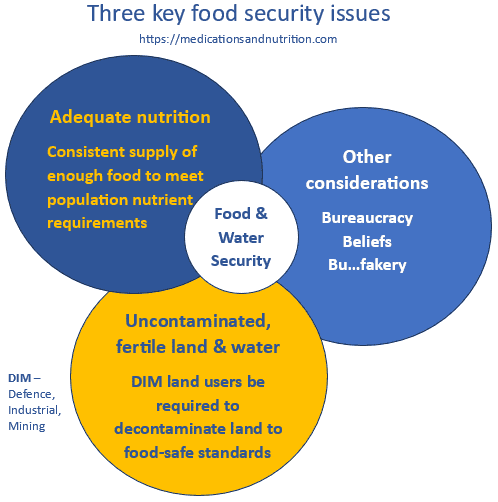
Key food security challenges, include -
Adequate Nutrition. Includes factors such as food choices, affordability, preparation methods, mixed “good nutrition” messages.
Uncontaminated water and fertile land. Competing interests for land include housing, commercial centres (towns), DIM (Defence, Industrial, Mining), national parks, location of ports, etc.
Other considerations. Increasingly unreliable weather patterns are triggering many food producers to move to the more moderate climates of coastal areas. Ultimately this means changing land useage and population densities.
Some Key Challenges
Declining availability of fertile land
In the last 60 years, productive land per capita in Australia has fallen from 3.5 hectares (1960s) to 1.9 hectares (2019).
Uncontaminated food-producing land and water are not perceived as “valuable”. If food security is to be achieved and maintained then it is very valuable.
Waste management
Waste management practices currently do not comprehensively remove pharmaceuticals and their metabolites which are then re-entering the food chain.
Recycled water from both industrial and domestic waste management systems may -
- contain pharmaceuticals and/or their metabolites,
- be applied to aquaculture, horticulture, viticulture, dairy pasture, lucerne, nurseries, hydroponics, cane fields, grain cropping, and likely others.
Landfill may contain contaminated matter, including pharmaceutical content which leaches into the surrounding land and underground waterways.
Incinerated contaminated matter can also be airborne.
DIM contamination
DIM operations occupy extensive areas of land that are not utilized to produce food. Further, their onsite operations typically -
- contaminate that land and water in perpetuity;
- have questionable weed, pest, and bushfire risk management strategies that can negatively impact neighbouring food-producing lands and water;
- rarely rehabilitate the land to food-safe standards.
Water rights
Current water rights preferentially favour high-value crops such as vineyards rather than less-high-value staple foods such as dairy, grains, etc.
Changing climate challenges
Extreme weather events and bushfire episodes reduce food diversity, quality, and affordability. After an adverse event, recovery to full productivity again costs months (salad vegetables) and years (grain production, beef production, dairying).
Increasing climate temperatures decrease food security, for example -
- rising sea levels are encroaching on productive coastal land,
- increasing ocean temperatures are decreasing fish stocks.
Health impacts
Contaminants such as toxic metals, industrial wastes, and pharmaceuticals diminish nutrient density and/or availability in food and increase mal-nutrition risks.
Roof top water harvesting Is essential for those not on “town-water” and is increasing in popularity within towns and cities. Contaminated dust settles on roof tops, contaminates the collected water and thus increases risks of health harm to the occupiers.
Hidden costs
Includes factors such as trade and competition policies, taxation policies, very powerful lobby groups, individual financial circumstances, and many others.
How can we support our own food security?
1. Food purchasing practices.
If Grow-Your-Own is not an option then your food purchasing practices are significant contributors to national food security. Do you buy foods that are produced –
- Locally. Do you buy from the local markets, or local growers with onsite sales?
- Nationally. Do you buy specific favourite foods online from a favourite food supplier? Do you buy most of your food from your local supermarket, and are your food choices dictated by price or country of production? If we (consumers) do not choose to support our food producers, then those food-producing skills and infrastructure will be lost.
- Internationally – supports food producers in other countries. Potentially unreliable food supply during significantly adverse times.
2. Investments.
Do you/does your super fund invest in businesses that do not contaminate land and water?
3. Advocacy for protection of uncontaminated land and water.
Do you/will you consider the contamination impact on food-producing land and water for any projects in your area? If the proposed projects do contaminate then what will you do? – no action implies support.
Clinical Question
It seems to me that nothing will be done until we start coupling drug-induced mal-nutrition with food insecurity. Will your clinical reports identify drug-induced mal-nutrition as a contributor to (that person’s) food insecurity?
Conclusions
Food security issues mean that we locally, nationally and globally, cannot afford to lose our food producers or lose food-producing land to projects that contaminate it in perpetuity.
Please read this as it is important …
The information in this article is provided to support Health Professionals. It is not an exhaustive protocol and Health Professionals are advised that adequate professional supervision is accessed to ensure that Duty of Care obligations with respect to safe administration of medicines is met for each consumer.