Pharmaceutical contamination in reality are its costs to health and to national food security. This post is about a currently unfolding scenario.
Pharmaceutical contamination scenario
Context
Since the importance of uncontaminated, fertile land to food security is not considered, it continues to be lost to contamination. The primary contaminators are the DIMP sector (Defence, Industrial, Mining, Pharmaceuticals).
A mining company has proposed a mineral sands mine on food-producing land, primarily animal production and a significant, $100+-million-dollar horticultural industry is immediately downwind. The horticultural industry is both multi-generational and a significant local employer.
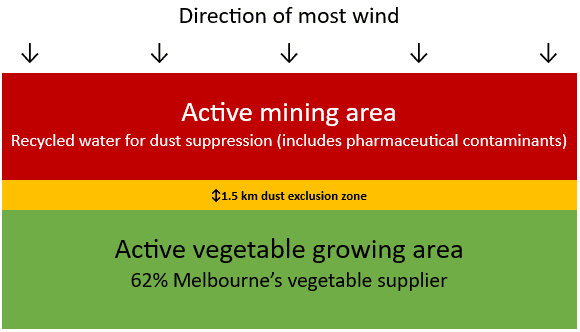
The local horticultural industry currently harvests more than 1600 tonnes vegetables per day. Their markets include capital cities on the eastern seaboard, national fast food and small supermarket chains, and South-East Asian countries. In fact, this horticultural site now provides 62% of Melbourne’s fresh vegetables.
Recycled water
The horticulture industry’s accreditation process includes a proven lack of dust contamination.
In order to protect the downwind horticulture industry, the mining proposal’s dust suppression strategies include the application of recycled water. The recycled water will be accessed from the local waste management service.
Recycled water is perceived to benign, and in fact beneficial as it saves the volume of fresh water being used.
Pharmaceutical consumption is ubiquitous and its contamination is in perpetuity. Waste treatment plants are currently unable to remove pharmaceutical contaminants from the waste. Until strategies to remove pharmaceutical contaminants are utilized, then there is also a harm component to recycled water..
Applying recycled water to food-producing land enables drug-resistance genes and microbiota to enter and move through the food chain. This movement means drug resistance enters our food supply and therefore enables drug resistance in humans and animals. Ultimately drug resistance means ineffective medical treatments and declining health.
The proposed mine is expected to be operational for 20+ years. Some questions –
- what percentage of the food-producing land and its surrounds will still be safe to produce food when the mine ceases operations?
- will recycled water spray blow across the 1.5 km exclusion zone?
- will contamination markers be monitored?
Applying recycled water to food-producing land is the equivalent of letting the nasty genie out of the bottle.
What can be done?
What can be done to prevent this potential, and likely, in perpetuity contamination of a significant food-producing area?
Those not perturbed by this pending devastation are, unsurprisingly the mining company, the Mining Regulator, and the many pro-mine politicians.
Those who should be perturbed include those working in the Departments for Health, Agriculture, Environment, and Therapeutic Goods Administration.
Those who are perturbed are very limited in number.
As this issue of pharmaceutical contamination is only starting to be realized -
- there are no regulatory frameworks;
- the research to identify effective removal strategies is still in the very early stages of development;
- the issue is very low on the research funding priority lists.
Question
How would you respond to this scenario?
Conclusion
Pharmaceutical contamination in reality is both the enhancement of drug resistance and the loss of a contributor to our national food security.
Please read this as it is important …
The information in this article is provided to support Health Professionals. It is not an exhaustive protocol and Health Professionals are advised that adequate professional supervision is accessed to ensure that Duty of Care obligations with respect to safe administration of medicines is met for each consumer.