Takeaways
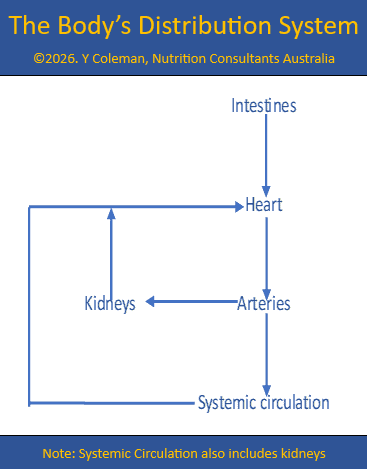
The body's distribution system operates on two scales: - macroscopic highway - the circulatory system, - microscopic gateway - the membrane transporters.
Different substances require custom transport mechanisms.
The body’s distribution system comprises a framework of local transporters, hubs, and systemic carriers. We see examples of this framework in operation in our social structures such as -
- the Postal Service. Designated sorting centres distribute to local hubs that then distribute by electric bike, truck etc, to the final destination;
- the suburban + interstate rail and bus networks. Trains and buses move travellers to centralised hubs where they connect with other (interstate) rail or bus system;
- the niche + national airline carriers. Similar concept to the rail and bus networks;
- the grain harvest network. Local trucks move grain to railhead silos, then grain trains move it to ports, and then ships move it to its next destination.
Distribution System in the Body
Essentially, local shuttle buses collect their load and move it to a departure point. At the departure point the load is transferred to a systemic carrier and moved to its destination. Upon arrival, a local shuttle bus then moves it to its point of operation.
Our knowledge of how the distribution system actually functions falls into 2 broad categories, being –
- the stuff we know – a very small category,
- the stuff we don’t know – a very, very, large category.
The stuff we know
Transporters
The shuttle buses aka the local delivery service. Approximately 9 transporters are required to be tested for and identified in the drug discovery process and Product Information documents. Although known, some are not required to be tested for and identified in the drug discovery process and Product Information documents eg glucose transporters. The vast majority are unknown and euphemistically referred to as “passive diffusion”.
Carriers
The systemic carriers that typically move load from a departure point to an arrivals point, for local distribution. The main carrier is albumin, followed by alpha-1 acid glycoprotein, and then several niche carriers.
The stuff we don’t know
The logistics of how it all functions. How does the load find the relevant transporter? Do the transporters wait for the load, or does the load wait somewhere until the transporter arrives? Does the load accumulate somewhere until a carrier arrives, or do the carriers wait for the load? Is there a designated “arrivals lounge” equivalent where the load waits until the relevant transporter arrives?
When aspirin inhibits vitamin C boarding the albumin carrier, what does the vitamin C then do? Does it wait until aspirin’s inhibition wears off, and then board the next available albumin? Or does it hop on a transporter back to the gut and be excreted?
If there is more load than capacity, what determines which waiting loads are, and are not, included?
Different substances can modify albumin’s structure and therefore function, and consequently also influences what it carries. It seems likely various substances have similar effects on other carriers.
Nutritional Consequences
What are the nutritional consequences of impairment to the distribution system? What determines which compound is preferentially selected when there is competition for the available transfer capacity? And what happens to the compound that is not selected?
How can we ascertain whether anomalies between food intake and blood test results are due to interferences in the distribution system?
Because we don’t have a very clear understanding of how the body’s distribution system functions, we are not aware of potential drug-distributor interactions that may also be negatively impacting our nutritional health.
Clinical Concerns
Given all pharmaceuticals utilise the body’s distribution system, and the research seems to be very limited, we are likely working with drug-nutrient interactions within the system already. We need –
1. regulatory requirement that drug impacts on all aspects of the body’s distribution system be included in the drug discovery process and included in the Product Information documentation;
2. a concerted research program to identify the negative impacts of alteration to the distribution system on nutritional factors;
3. a concerted research program to identify strategies to ensure nutrient “preference for transfer” by the distribution system, to minimise exogenous negative impacts.
Clinical Questions
What actions will you initiate as you a review a person’s prescribed medications, will you -
- consider opportunities to increase nutrient uptake as a strategy to offset impairment to the distribution system?
Conclusions
The distribution system is a likely source of a range of potential drug-nutrient interactions that are currently unknown.
Cite: Coleman, Y. 2025. The Distribution System. MedNut Mail https://medicationsandnutrition.com/the-distribution-system/ Accessed (date)
The distribution system
Professional Notice
The information in this article is provided to support Health Professionals. It is not an exhaustive protocol and Health Professionals are advised that adequate professional supervision is accessed to ensure that Duty of Care obligations with respect to safe administration of medicines is met for each consumer.
Core Philosophy
Whilst medications have profoundly improved global health outcomes, they typically also introduce nutritional challenges. By proactively identifying and addressing these nutritional harms, we can bridge the gap towards achieving better health outcomes.