Drug administration for dysphagia is a fraught issue. Many pharmaceutical manufacturers recommend their products not be crushed, chewed, dissolved … which is fine if swallow capability is uncompromised. However, approximately 8% of the global population has dysphagia, with the elderly and disability sectors being particularly well represented. How can we safely administer prescribed medicines to those with dysphagia?
Dysphagia
Dysphagia encompasses all the factors that delay delivery of substances from the mouth to the stomach. The impairment can be acute or chronic, intermittent or persistent, mechanical (blockage) or motility (altered). Ultimately, dysphagia can negatively impact a person’s health, well-being, and quality of life.
Dysphagia is broadly divided into 2 types –
- oropharyngeal - problems in the mouth and pharynx. Typically includes difficulty in initiating a swallow, or in passing food through the mouth or throat;
- oesophageal - problems in the oesophageal body and esophagogastric junction. Typically includes structural or inflammatory abnormalities, or motility disorders.
IDDSI Guidelines
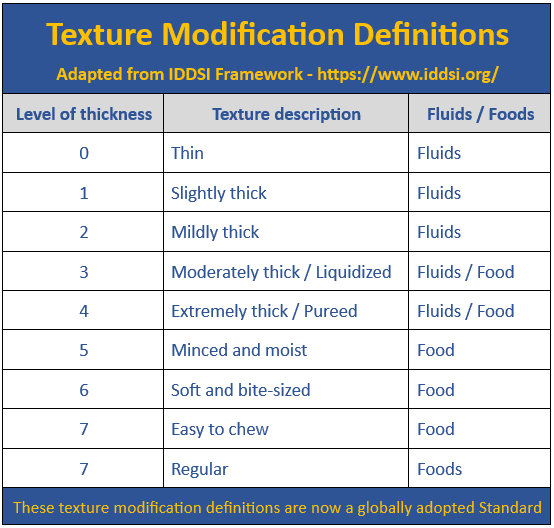
IDDSI is the International Dysphagia Diet Standardisation Initiative (https://www.iddsi.org/).
Dietitians and Speech Pathologists created a working party to develop and implement a global Standard to describe current and desired textures of orally consumed substances. The purpose of this Standard is to enable safe swallowing in those with dysphagia.
IDDSI is now fully implemented which means the same terms and consistencies are applicable in any health service anywhere globally. This is an amazing achievement.
The ultimate aim is for all substances available for human oral consumption to be swallowed safely.
Drug administration
All consumed substances including medicines, must be administered in a form that is safe for individual intake. Alteration to medicine form, such as crushing, comes with a range of unintended consequences such as –
- altering drug absorption dynamics,
- altering drug stability,
- causing local (oesophageal, stomach) irritation,
- non-delivery of drug to desired site of action,
- increasing occupational health and safety risks to the person modifying the drug form. Harm can be caused due to skin exposure and/or inhalation,
- exposure of the consumer to unacceptable tastes. In this case compliance is the issue rather than effectiveness.
Consequently, some key questions that need to be asked include -
- can this drug be crushed or dispersed?
- can the capsule be opened?
- do any of this person’s currently prescribed medicines also compromise swallow function/safety?
- does this person’s swallow capability fluctuate during the day? Is their swallow capability safe whilst they are alert, and/or does it deteriorate with drowsiness/fatigue? And is this fluctuation consistent or intermittent?
- do the manufacturer’s recommended administration strategies comply with the IDDSI Standard?
- is this drug available in a safe-for-this person, format?
- are there onsite drug administration guidelines for this person with dysphagia?
- does this person still require this medicine?
Currently there is no regulatory requirement for dysphagia and enteral feeding guides to be included in the Product Information documents. Some of the pharmaceutical companies have differentiated between their customers (typically pharmacists and chemists) and their end-users (typically consumers of their products), and include this information in their Product Information documents.
Drug-induced dysphagia
Drug-induced dysphagia occurs when pharmaceutical products negatively impact the swallow reflex. Many commonly prescribed medicines have the potential to affect swallowing either –
- Directly – by impairing the swallow reflex;
- Indirectly – by causing drowsiness, dry mouth, oesophageal injury, or impairment to swallow muscle function, whereby the swallow reflex capability is compromised.
Key management/administration strategies
- Clarify whether the current medicines can be administered in alternate forms such as patches, pessaries, injectables. Note – there may be privacy, dignity and personal safety concerns with regular pessary administration.
- Always administer the drug with the same foodstuff to ensure consistency in drug effectiveness. Drug availability and effectiveness is altered by various foodstuffs. DO NOT grab the nearest foodstuff in the fridge or cupboard and mix the medicine into it. Over the years I have seen nurses administer drugs with apple sauce, honey, custard, jam, (not yet melted) ice cream, mashed potato, mashed pumpkin, pureed food of indeterminate content, and others!
- Record IDDSI level, and administration foodstuff on the drug chart and in each person’s Care Plan. A list of uncrushable drugs, and their alternatives, should also be attached to the drug chart as an easily-accessed resource.
- Ask your supplying pharmacist if they could provide a list of non-crushable drugs and their alternatives. If they can’t then ask if someone on light duties (WorkCover) can compile the list.
- If safe administration guidelines for a particular drug are unavailable, then ring the relevant drug company and ask for their recommendations. Document the advice given, note the person’s name and role, have someone else also listen to the conversation, and you both sign the entry in the Notes. This demonstrates you have sought “best possible advice” prior to initiating an action.
- Develop policies outlining drug administration for those with the various levels of dysphagia, and for those requiring enteral feeding. Submit the policies to your Medication Advisory Committee (MAC) for endorsement and distribution to all members.
- The policies should include if and when pill-crushing devices are to be used. Pill-crushing devices crush to the same standard every time whilst individuals crush to different standards. Variability in the crushing alters drug availability and effectiveness.
- Standardize the drug administration for dysphagia process and note on the drug chart where the guideline is filed. This is useful for new and casual staff. Standardizing the process limits potential harm.
- Include your standardized drug administration for dysphagia processes in each new staff member’s orientation program. Ensure skills and understanding are demonstrated before allowing new staff to administer any drugs to those with dysphagia.
- Clarify drooling management strategies if there is concurrent dysphagia and medication administration.
- For those services that may not have a MAC, there are some options worth considering such as -
- attending some MAC meetings at your local RACF (Residential Aged Care Facility) prior to setting up your own MAC,
- canvassing the possibility of submitting some policies to one of your local RACF MAC meetings. This will enable medical, pharmaceutical, and hopefully nutrition and speech pathology, insights;
- organizing joint RACF MAC meetings X times per year;
Your policies and procedures both increase the likelihood and emphasize the importance of correct drug administration. In Victoria, death by choking automatically triggers a Coronial investigation. This regulatory requirement has significantly improved drug administration compliance.
Clinical Concerns
How many people in your care diagnosed with dysphagia are prescribed medicines that include dysphagia as a side effect? If the prescribed medicines were changed to alternatives that did not include dysphagia as a side effect, then is it likely will the dysphagia resolve?
Do you, or have you heard any doctor, pharmacist, nurse or other health professional, question whether other prescribed medicines are contributing to, or exacerbating the person’s dysphagia? I haven’t.
How compliant is drug administration with the IDDSI Guidelines? Is IDDSI compliance with drug administration a standard inclusion in all Care audits?
Managing dysphagia, and especially drug-induced dysphagia, does not seem to be integrated into the daily clinical practice of relevant clinicians. Perhaps it is time for all the relevant professional bodies, universities and other training institutions to address this profoundly relevant clinical oversight.
Clinical Questions
What actions will you initiate as you a review a person whose diagnoses includes dysphagia, will you -
- identify each of the prescribed medicines that directly causes dysphagia? And question whether any can be changed to an equivalent that does not cause dysphagia?
- clarify and monitor whether the dysphagia fluctuates?
- clarify whether there are appropriate, IDDSI-compliant, drug administration guidelines onsite?
- audit, or recommend regular auditing of current medicine-modification strategies for compliance with IDDSI guidelines?
- attend a MAC meeting and possibly become a member?
Conclusions
Drug administration for dysphagia raises many concerns in relation to both safe administration, and compliance with IDDSI guidelines.
Useful Resources
Cite: Coleman, Y. 2025. Drug administration for dysphagia. MedNut Mail https://medicationsandnutrition.com/drug-administration-for-dysphaia/ Accessed (date)
Drug administration for dysphagia
Professional Notice
The information in this article is provided to support Health Professionals. It is not an exhaustive protocol and Health Professionals are advised that adequate professional supervision is accessed to ensure that Duty of Care obligations with respect to safe administration of medicines is met for each consumer.
Core Philosophy
Whilst medications have profoundly improved global health outcomes, they typically also introduce nutritional challenges. By proactively identifying and addressing these nutritional harms, we can bridge the gap towards achieving better health outcomes.