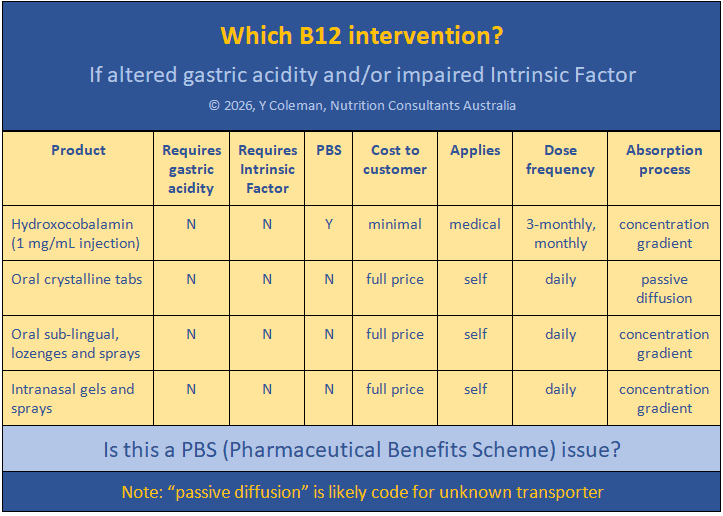
B12 Injections and the PBS (Pharmaceutical Benefits Scheme) are an unlikely combination. Injectable B12 is the primary management strategy for those with altered gastric acidity and/or Intrinsic Factor. Why is this a PBS issue?
Mechanisms and consequences
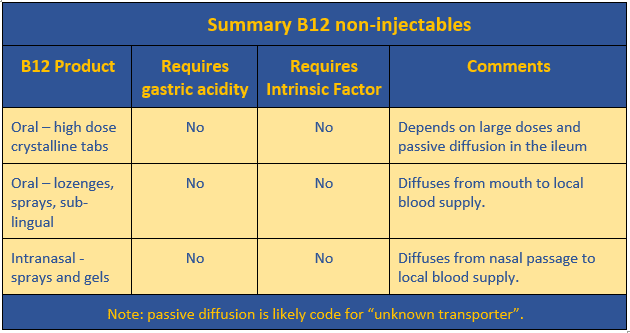
Non-injectable B12 products that do not require gastric acidity and/or Intrinsic Factor (IF) are now available to support B12 absorption. The evidence indicates their doses are therapeutically effective.
B12
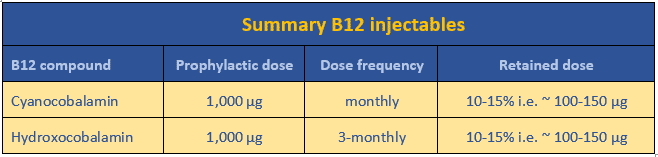
B12 injections are commonly prescribed and often for many years, to fulfil 2 key functions –
- reverse B12 deficiency, especially if severe;
- provide ongoing accessible supply of B12 for those with altered of gastric acidity and/or Intrinsic Factor.
Absorption
Injected free B12 diffuses through the extracellular fluid into nearby capillaries, enters the bloodstream and binds to TCII (transcobalamin II). The process is based on an absorption gradient – high at site of injection and low in the blood. Because B12 in the blood is continuously removed, the concentration gradient remains relatively constant.
Once their TCII’s binding capacity is exceeded, the kidneys excrete excess B12 in the urine. Limited renal B12 reabsorption may occur with the TCII receptor megalin (Lrp2) transporter.
Alternative product options
Non-injectable B12 products that do not require gastric acidity and/or Intrinsic Factor to enhance B12 absorption include –
Elevated B12 levels
B12 levels are rarely monitored once they are within acceptable range, and elevated levels if identified, are not addressed.
Whether elevated B12 levels cause harm is currently contentious. However, evidence of elevated-B12-induced harm is steadily increasing. Definitions of elevated levels seem to be a bit wobbly, and a lot more, high quality evidence is definitely required.
Long-term administration of prophylactic B12 injections is likely to elevate B12 levels, therefore harm management strategies could include -
- regular monitoring of B12 levels, preferably 3-6 monthly;
- frequency of the intervention be reviewed if B12 levels are high-normal or elevated.
If harm at high doses is established then perhaps B12 has a therapeutic range, outside of which it causes harm. Evidence is increasing that elevated levels of some other B vitamins and some minerals are also associated with increased harm. Are these early indicators that therapeutic ranges are applicable for all nutrients?
Pharmaceutical Benefits Scheme (PBS)
The PBS is the vehicle by which the government subsidises the cost of medicine for most medical conditions.
The PBS only lists prophylactic B12 injections for maintaining B12 status in those with impaired gastric acidity and/or Intrinsic Factor. Acceptable alternative options have only recently become available.
Non-injectable products offer a range of benefits, including –
- less invasive,
- less costly,
- a range of administration options that can suit personal preference, impaired swallow reflex capability, and/or enteral feeding,
- administration on a daily basis which means lower doses and therefore reduced B12 peaks and troughs.
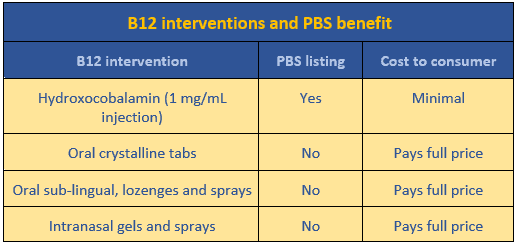
The advent of more B12 administration options means the PBS can expand current support to include user-administered options.
PBS listing is a significant influencer of medicine prescribing practices.
Clinical Assessment management
Consider including in your assessments a recommendation to -
- check B12 levels prior to the next injection, or every 3 months, to clarify status;
- review the frequency of the intervention if B12 levels are near or above the acceptable range. For example, if the current frequency is 3-monthly then change to 6-monthly;
- continue to regularly monitor B12 status every 3-6 months to ensure levels stabilize well within acceptable range.
Clinical concerns
What actions will you initiate when you see someone whose diagnoses include impaired gastric acidity and/or Intrinsic Factor, and prescribed B12 injections, will you -
- check B12 levels and clarify status?
- recommend reducing intervention frequency if B12 levels are elevated, and continue to monitor?
- question whether injections are still required or whether a non-injectable product can be prescribed?
Conclusions
B12 injections are one of several prophylactic B12 options now available for those with altered gastric acidity and/or Intrinsic Factor.
Researched and written by the author.
Cite: Coleman, Y. 2026. B12 injections and QUM. MedNut Mail https://medicationsandnutrition.com/B12-injections-and-PBS/ Accessed (date)
Bibliography
Bibliography |
|---|
PBS website. 2026. https://www.pbs.gov.au/pbs/home. Accessed 2026-02-17 |
Moravcová, M., Siatka, T., Krčmová, LK., Matoušová, K. & Mladěnka, P. 2025. Biological properties of vitamin B12. Nutrition Research Reviews 38(1):338-370. https://doi.org/10.1017/S0954422424000210 |
Fedosov, SN. & Nexo, E. 2024. Macro-B12 and Unexpectedly High Levels of Plasma B12: A Critical Review. Nutrients 16(5):648. https://doi.org/10.3390/nu16050648 |
Vasavadam A., Patel, P. & Sanghavi, DK. 2024, Cyanocobalamin. [Updated 2024 Jan 31]. In: StatPearls [Internet]. Treasure Island (FL): StatPearls Publishing; 2025 Jan-. Available from: https://www.ncbi.nlm.nih.gov/books/NBK555964/ |
Ramezanpour Ahangar, E. & Annamaraju, P.2023. Hydroxocobalamin. [Updated 2023 May 29]. In: StatPearls [Internet]. Treasure Island (FL): StatPearls Publishing; 2025 Jan-. Available from: https://www.ncbi.nlm.nih.gov/books/NBK557632/ |
Wentworth, BJ. & Copland, AP. 2018. Revisiting vitamin b12 deficiency: a clinician’s guide for the 21st century. Nutrition Issues in Gastroenterology 182:25-49. https://med.virginia.edu/ginutrition/articles-from-practical-gastroenterology/ |
Cappello, S., Cereda, E., Rondanelli, M., Klersy, C., Cameletti, B., Albertini, R., Magno, D., Caraccia, M., Turri, A. & Caccialanza, R. 2016. Elevated Plasma Vitamin B12 Concentrations Are Independent Predictors of In-Hospital Mortality in Adult Patients at Nutritional Risk. Nutrients 9(1):1. https://www.mdpi.com/2072-6643/9/1/1 |
Please read this as it is important …
The information in this article is provided to support Health Professionals. It is not an exhaustive protocol and Health Professionals are advised that adequate professional supervision is accessed to ensure that Duty of Care obligations with respect to safe administration of medicines is met for each consumer.